Kitchen Organiser Boxes: Types and How to Choose
A professional organiser's unbiased guide to selecting the right storage containers — from material comparisons to common mistakes, written for Indian kitchens.
Jump to section
Why Kitchen Organiser Boxes Matter
A disorganised kitchen costs you more than you realise. Every minute spent searching for the turmeric in a jumbled shelf, every packet of dal that goes stale because the bag wasn't sealed properly, every duplicate purchase of something you already own but couldn't find — these small annoyances add up to real waste of time, money, and energy.
The hidden cost of a disorganised kitchen
In Indian households where cooking is done twice or even three times a day, kitchen clutter exacts an especially high toll. A disorganised kitchen leads to:
- Food wastage — improperly stored grains, spices, and perishables go stale or attract pests faster. In Bangalore's humid climate, an open packet of rava can spoil within days
- Duplicate purchases — buying another packet of jeera because you couldn't find the half-used one buried at the back of the shelf
- Stress and frustration — a cluttered cooking space makes meal preparation feel like a chore
How the right organiser boxes save time, money, and reduce food waste
Quality kitchen organiser boxes transform your kitchen from a source of daily friction into a space that works for you:
- Visibility — clear containers let you see exactly what you have and how much is left, preventing duplicate purchases and last-minute grocery runs
- Freshness — airtight seals keep moisture, pests, and air out, extending shelf life by weeks or even months. This is critical in tropical climates where humidity is a constant challenge
- Speed — when every container has a dedicated home and a clear label, meal prep becomes faster. You spend less time hunting and more time cooking
- Space efficiency — stackable, uniform containers maximise your existing cabinet and shelf space. Modular designs let you use every inch of vertical storage that is currently wasted
The growing demand for kitchen storage products reflects how much people value this transformation, and eco-friendly options are becoming increasingly popular. This is not a niche concern; it is one of the most sought-after home improvements worldwide.
A well-organised kitchen is not about perfectionism — though that is a nice bonus. It is about reclaiming your time, reducing waste, and making one of the most-used rooms in your home a genuinely pleasant place to be. And it starts with choosing the right organiser boxes.
Types of Kitchen Organiser Boxes Explained
Not all organiser boxes serve the same purpose. Understanding the different categories helps you buy only what you actually need — rather than whatever looks good on a website or in a store display.
Airtight containers for dry goods and staples
These are the workhorses of any organised Indian kitchen. Designed to store flour, rice, dal, sugar, pasta, and other dry staples, airtight containers are the single most important category to get right.
What to look for: Snap-lock lids with silicone gaskets provide the best seal. Clamp-style lids (with a lever on each side) are also excellent. Avoid simple press-on lids — they lose their seal quickly and will not protect against Bangalore's humidity.
Size guide for Indian households: A 1 kg pack of atta needs roughly a 1.5-litre container. For dal and rice, 2-3 litre containers work well for bulk storage. Keep a few 500 ml containers for smaller quantities of poha, sabudana, and other breakfast staples.
Best materials: BPA-free plastic for lightweight daily use; glass for long-term storage of frequently accessed items; stainless steel for direct food contact with oily ingredients.
Fridge storage boxes and crisper organisers
Clear fridge organisers make a dramatic difference because fridge clutter is invisible clutter — you do not see what is hiding at the back until it is too late.
What to look for: Stackable designs with ventilation. Some produce-specific containers include small vents to manage ethylene gas, keeping vegetables fresher longer. Clear plastic is essential — tinted or opaque boxes defeat the purpose.
Zone-based fridge organisation: Dedicate separate boxes for different categories — one for curry leaves and fresh greens, one for cut vegetables, one for dairy, and one for leftovers. This prevents cross-contamination and makes meal prep faster.
Stackable modular systems for pantry and cabinets
Modular systems are designed to work together — containers of different heights and footprints that all share the same base dimensions, so they stack securely and look uniform.
What to look for: Interlocking bases and lids that prevent sliding when stacked. Systems that offer multiple sizes within the same footprint are the most versatile. The IKEA 365+ range (available at IKEA Bangalore) and similar modular lines from Indian brands let you build a collection over time rather than buying everything at once.
Where modular systems shine: Deep base cabinets where you need pull-out access, open pantry shelving where visual uniformity matters, and under-sink storage where odd-shaped spaces benefit from standardised containers.
Spice jars and seasoning organisers
Indian kitchens use more spices than almost any other cuisine — a typical household has 20-30 different spices in regular rotation. Standardising your spice storage is one of the highest-impact organisational moves you can make.
What to look for: Airtight glass jars with shaker tops or wide mouths. Jar racks that mount inside cabinet doors save counter space. Drawer-based spice inserts work well if you have a dedicated shallow drawer near the cooking zone. Avoid traditional masala dabbas with loose-fitting lids — they let moisture in and flavours out.
Size considerations: Small jars (100-200 ml) for daily-use spices like haldi, mirchi, and jeera. Medium jars (300-400 ml) for frequently used whole spices and blends. Keep a separate rack or shelf for bulk refill bags stored elsewhere.
Countertop organisers and utility boxes
These are the containers you reach for multiple times a day — tea, coffee, sugar, snacks, and frequently used condiments. Because they live on the counter, aesthetics matter alongside function.
What to look for: Easy-open lids (flip-top or pop-up), compact footprints that do not crowd your work surface, and materials that are easy to wipe clean. Multi-compartment boxes that hold tea bags, sugar sachets, and stirrers in one unit are practical for the beverage station. Choose containers that match your kitchen's aesthetic — bamboo, ceramic, or matte-finish plastic — since they will be on display.
How to Choose the Right Kitchen Organiser Boxes
With the types clear, the next step is knowing how to compare options and pick the right ones for your specific kitchen. These four factors — material, size, lid quality, and budget — cover the decisions that matter most.
Material comparison: plastic vs glass vs stainless steel vs bamboo
Each material has real trade-offs. There is no single "best" material — the right choice depends on what you are storing and how you use your kitchen.
Plastic (BPA-free): Lightweight, affordable, and available in every size and shape. Best for dry goods, pantry storage, and fridge organisers. The downside: plastic can stain with turmeric and retain curry odours over time. Always verify the food-grade certification mark (ISI or equivalent) when buying in India — cheap unmarked plastic may leach chemicals, especially with oily or acidic foods.
Glass: Does not stain, does not retain odours, and is microwave- and dishwasher-safe. Ideal for everyday-use containers and anything stored with oil. The trade-offs: heavier, more expensive, and breakable. Worth the investment for frequently accessed containers that you want to last.
Stainless steel: Lightweight and nearly indestructible. Excellent for direct food contact, especially with oily or wet ingredients. The downside: you cannot see the contents, so labelling is essential. Best for large-volume storage of staples you buy in bulk.
Bamboo and wood: Attractive for countertop organisers and dry storage. Naturally antimicrobial. However, they are not airtight and not suitable for long-term food storage. Best used for tea, coffee, and snacks kept in daily rotation.
Size and capacity: measuring before you buy
The single most common mistake in kitchen organisation is buying containers that do not fit. Before purchasing anything, measure your cabinet interiors:
- Depth — measure from the back wall to the front edge of the shelf. Get containers that use the full depth without protruding
- Height — measure the clearance between shelves. Allow 2-3 cm of finger room above the container for easy grabbing
- Width — decide whether you want containers that span the full shelf width or smaller modular units that can be rearranged
Volume guidelines: 1 kg atta ≈ 1.5 L; 1 kg rice ≈ 1.2 L; 1 kg dal ≈ 1.4 L; 500 g sugar ≈ 0.7 L. For Indian kitchens, err on the side of slightly larger containers — our cooking quantities tend to run larger than Western recipe standards assume.
Lid types and seal quality: what matters for freshness
The lid makes or breaks a container. A good body with a poor lid is useless. Here is how the common lid types compare:
- Snap-lock with silicone gasket — best all-round option. Creates an airtight seal that keeps moisture and pests out. Look for lids with four locking flaps rather than two for even pressure
- Screw-top — excellent seal, but slower to open and close. Best for items you access weekly rather than daily
- Clamp lid (Kilner-style) — strong seal with a satisfying mechanism. Bulkier than snap-lock and more expensive, but very durable
- Simple press-on — avoid these for food storage. They lose seal quality quickly and will not protect against humidity or pests
How to test seal quality in a store: Press the closed container between your palms. If you feel air escaping or the lid flexes, the seal is weak. A properly sealed container should feel solid with no give.
Budget considerations: quality vs quantity
It is tempting to buy a large "complete set" of containers at a low price. In our experience organising Bangalore kitchens, those sets are almost always a false economy. Within six months, the lids stop sealing, the plastic warps, and you end up replacing them anyway.
Where to invest: Daily-use containers for atta, rice, sugar, and spices. These should be the best quality you can afford — glass or high-grade BPA-free plastic with silicone-gasket lids.
Where to save: Occasional-use containers for seasonal items, bulk overflow storage, and non-food organisers (under-sink, cleaning supplies). Basic BPA-free plastic works fine here.
A professional organiser's rule of thumb: Start with 6-8 quality containers for your most-used items. Add more only after you have lived with those for a month and know exactly what else you need. A curated collection of 12-15 well-chosen containers serves most Indian kitchens better than a 30-piece set where half the sizes go unused.
7 Mistakes to Avoid When Buying Kitchen Organiser Boxes
In our years of organising kitchens across Bangalore, we have seen the same mistakes repeated over and over. Avoiding these seven pitfalls will save you money, frustration, and cabinet space.
1. Buying organisers before decluttering
This is the number one mistake — and it is nearly universal. People get excited about organising, buy a set of beautiful containers, and then discover that half their pantry items have expired, they do not need that many containers for dal, and the fancy spice jars do not fit their masala collection.
The Tidy Blueprints approach: Sort and purge first. Empty every shelf and drawer. Discard anything expired. Donate unopened items you will not use. Only then — with a clear picture of what you actually need to store — should you buy containers. You will almost certainly need fewer containers than you think, and the ones you do buy will be the right sizes.
2. Choosing style over function
Instagram-worthy containers are appealing, but a beautiful jar that does not seal properly or a set of matching boxes that do not stack is worse than no container at all. We have seen clients spend heavily on aesthetic containers that let moisture in, stain immediately with turmeric, or are so heavy that lifting them from a high shelf is a daily struggle.
Guideline: Function first, aesthetics second. A well-sealing, appropriately sized container that is easy to clean and handle will serve you for years. If it also looks good, that is a bonus — but never the primary criterion.
3. Ignoring your kitchen's specific dimensions
Kitchens vary enormously in cabinet depth, shelf height, and corner configurations. Indian modular kitchens, in particular, have standard dimensions that differ from Western kitchens. Buying containers without measuring leads to wasted space, containers that protrude awkwardly, or shelves that cannot close.
What to measure: Depth of your deepest cabinet, height between shelves (minus 2-3 cm for finger clearance), and the width of your narrowest shelf. Deep corner cabinets often need pull-out boxes with front access. Shallow upper shelves work better with shorter, wider containers rather than tall narrow ones.
4. Overlooking material safety and long-term durability
Not all plastic is food-safe — and in the Indian market, quality varies dramatically. Cheap, unmarked plastic containers can leach BPA and other chemicals, especially when in contact with hot, oily, or acidic foods. Look for containers with the ISI mark, food-grade certification, or explicit "BPA-free" labelling.
When glass is worth the weight: For anything stored with oil (pickles, fried snacks, tadka mixes), glass or stainless steel is safer than plastic. For daily-use containers that go through the dishwasher regularly, glass outlasts plastic by years.
5. Falling for 'complete set' marketing
Pre-packaged sets of 20 or 30 containers seem like great value — but in practice, every set includes sizes you will never use. That tiny 100 ml container that is too small for anything useful, the giant 5-litre box that does not fit in any cabinet — these are wasted money and wasted cupboard space.
Better approach: Build a custom collection. Start with the 6-8 containers you know you need. Live with them. Add purposefully over time. A curated collection of containers that all earn their shelf space serves you far better than a "complete" set where half the pieces gather dust.
6. Skipping the lid test
A container that looks great on the shelf but has a weak lid is not a storage solution — it is a pest invitation. In Indian kitchens, where we store atta, rice, dal, and sugar in quantities that last weeks, a poor seal means moisture ingress, pest infestation, and spoilage.
Quick test: Press the closed container firmly. If air escapes, the seal is compromised. Snap-lock lids should click firmly into place on all four sides. Silicone gaskets should be seated evenly with no gaps.
7. Over-organising — buying containers for things that do not need them
Not everything in your kitchen needs a dedicated container. Whole onions, potatoes, and garlic store better with airflow. Spices you use in tiny quantities (star anise, mace) are fine in their original packaging if stored in a cool dark drawer. Packaged snacks that are finished within days do not need decanting.
The professional organiser's rule: Containerise what you use regularly and what benefits from airtight storage. Leave the rest alone. Over-organising wastes money and creates maintenance work — you will spend more time refilling and washing containers than actually cooking.
2026 Trends: What's Changing in Kitchen Storage
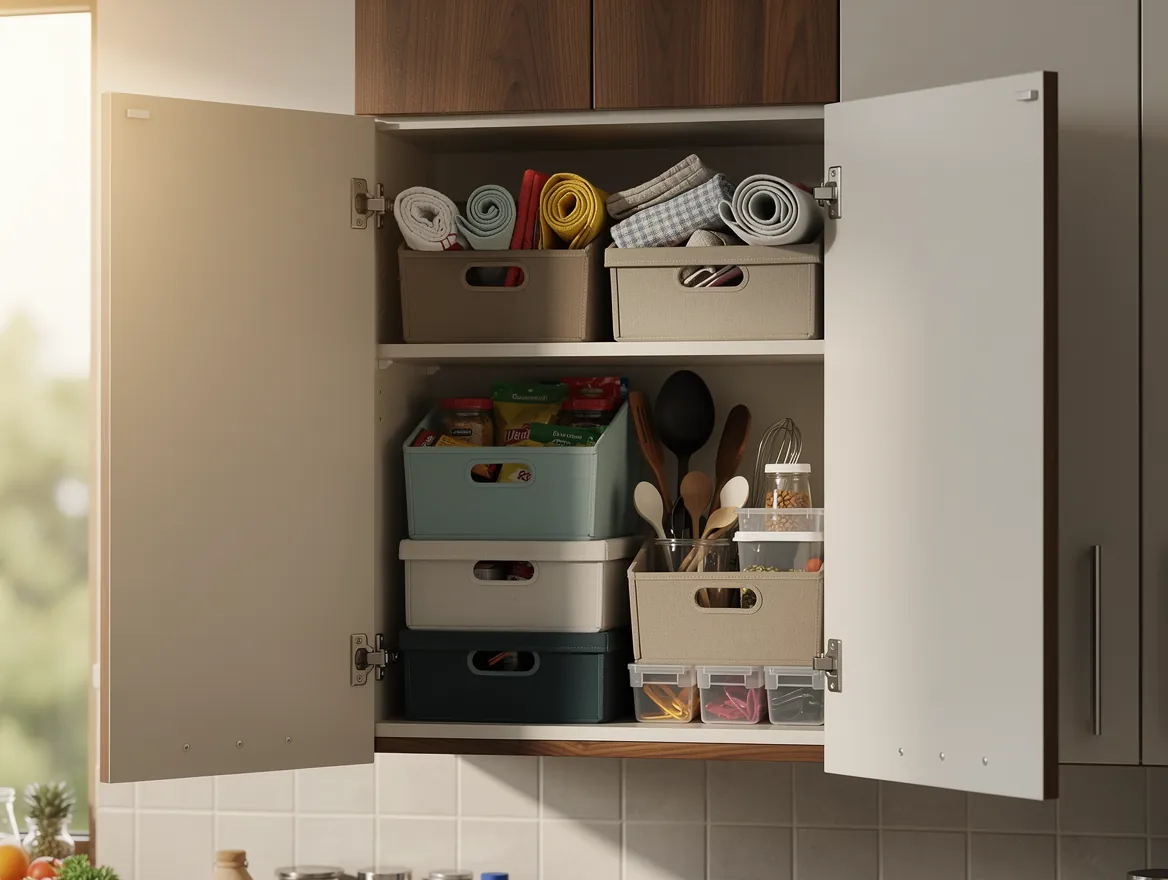
Kitchen storage is evolving fast — driven by material innovation, smart design, and changing consumer priorities. Here are the three trends shaping the organiser box market this year and what they mean for your kitchen.
Hidden and integrated storage solutions
The 2026 Houzz Kitchen Trends Study revealed that four in five homeowners (80%) are adding hidden storage features during kitchen renovations — pull-out larders, integrated bins, appliance garages, and concealed drawer systems. The trend is clear: people want their kitchens to look clean and uncluttered, with storage tucked out of sight.
What this means for you: Even without a full renovation, you can apply the hidden-storage principle. Choose organiser boxes that fit entirely inside your existing cabinets rather than sitting on countertops. Pull-out bins for base cabinets, drawer dividers with matching containers, and under-sink organisers all achieve the same clutter-free look without construction work. If you are planning a kitchen renovation, consider building pull-out organisers into your cabinet design from the start — the investment pays off every single day.
Sustainable and BPA-free materials gain ground
Health-conscious consumers are driving a significant shift away from conventional plastics. BPA-free glass containers are experiencing a market surge, with brands like TRONCO launching dedicated BPA-free glass lines. Bamboo and wood containers are growing in popularity for dry storage, and recycled plastic options are entering the mainstream.
What this means for you: When buying new containers in 2026, prioritise glass for daily-use items that come in contact with food. Look for certifications — ISI, FDA food-grade, or explicit BPA-free labelling. For plastic containers you already own, replace any that show signs of wear (scratches, clouding, warping), as these are more likely to leach chemicals. The good news: glass and bamboo containers are more affordable than ever, and they last far longer than plastic, making them a better long-term investment.
Smart modular and vacuum-fresh systems
Innovation in kitchen storage is accelerating. The 2026 Canton Fair showcased modular stackable systems that adapt as needs change. Red Dot Design Award winners like the ZWILLING Fresh & Save CUBE and SmartStore Module demonstrate that top-tier industrial design is now focused on everyday kitchen storage. Vacuum-seal technology — once limited to commercial kitchens — is moving into home use with affordable, compact systems.
What this means for you: Modular systems that let you add containers over time are a smarter buy than fixed sets. Look for brands that commit to backward compatibility — meaning the containers you buy today will still work with the ones released next year. Vacuum-seal containers are worth considering for items you store for extended periods, like bulk-purchased rice, flour, or festive-season dry fruits. They cost more upfront but dramatically extend shelf life.
A Professional Organiser's Perspective: How We Select Boxes for Clients
After organising dozens of kitchens across Bangalore, we have developed a systematic approach to selecting organiser boxes. This is not theory — it is what we do every day for real clients with real kitchens, real budgets, and real spice collections.
The Tidy Blueprints approach to kitchen organisation
Our methodology follows a deliberate sequence — and the container selection step comes surprisingly late in the process:
- Assess — We examine the entire kitchen: cabinet dimensions, shelf configurations, corner spaces, what is stored where, and how the family actually cooks. A kitchen where one person cooks simple meals daily needs different storage than a joint-family kitchen producing three elaborate meals
- Declutter — Everything comes out. Expired items are discarded. Duplicates are consolidated. Rarely used appliances are relocated. Only what remains after this purge gets containerised
- Measure — Every shelf, drawer, and cabinet is measured precisely. We record depth, height, and width for every storage zone. This data drives every container purchase
- Zone-plan — The kitchen is divided into functional zones: cooking zone (near the stove), prep zone (near the counter), storage zone (pantry and cabinets), cleaning zone (near the sink), and beverage zone (kettle, tea, coffee). Each zone gets container types suited to its purpose
- Select — Only now do we choose containers — and we buy them zone by zone, not all at once
- Install and label — Everything goes into its home. Labels are applied. The system is tested for a week
- Maintain — We teach clients a simple monthly reset routine so the system does not decay over time
Kitchen zones and the right box for each zone
Different zones need different container characteristics:
Cooking zone (near the stove): Heat-resistant, easy-clean containers within arm's reach. Small glass jars for daily spices (haldi, mirchi, jeera, dhaniya). A medium-sized airtight container for salt. Stainless steel or glass containers for cooking oils — never plastic near heat. Magnetic spice racks on the backsplash or inside cabinet doors keep the most-used spices visible and accessible.
Prep zone (counter space): Medium to large containers that are easy to open one-handed. This is where you keep atta, rice, and frequently used dals in daily-access containers. Wide-mouth jars so measuring cups fit inside. Stackable designs that maximise vertical space without crowding the work surface.
Storage zone (pantry and deep cabinets): Large-capacity airtight containers for bulk storage. This is where the 3-5 litre containers live — for backup stocks of rice, atta, sugar, and dal. Stackable is essential. Clear plastic so you can see levels at a glance. Label the front and the lid so you can identify contents from any angle.
Cleaning zone (under sink): Moisture-resistant containers for scrubbers, cloths, and cleaning supplies. No food storage in this zone — keep cleaning products separate. Small bins or caddies that can be pulled out easily.
Beverage zone: Compact countertop organisers for tea bags, coffee, sugar, and stirrers. Aesthetically pleasing since this zone is often on display. Bamboo, ceramic, or matte-finish containers work well here.
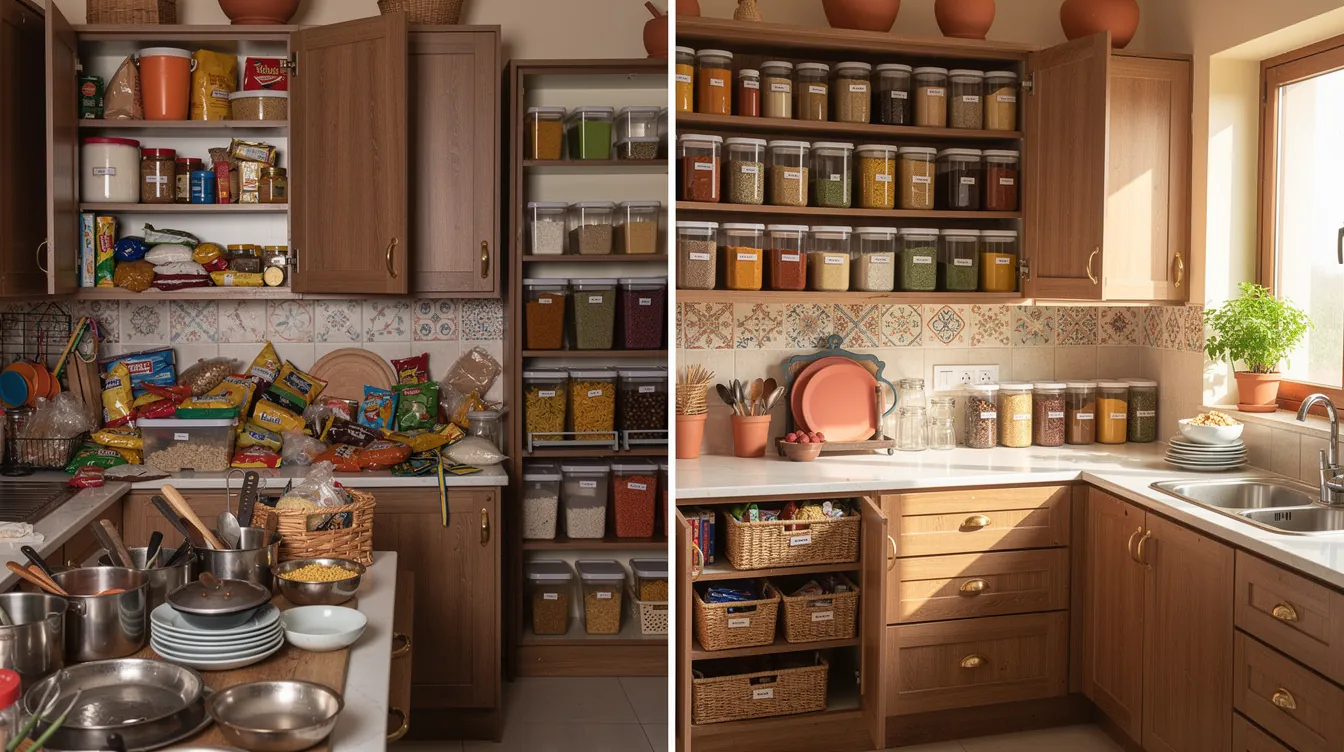
This zone-based approach is what separates professional organisation from simply buying nice containers. It ensures every box has a specific job in a specific place — and that the whole system works together as a kitchen that is genuinely easy to use, not just good-looking in photographs.
Frequently Asked Questions About Kitchen Organiser Boxes
What are the best kitchen organiser boxes for Indian kitchens?
For Indian kitchens, prioritise airtight containers with strong seals to protect against humidity and pests. Glass or BPA-free plastic with silicone-gasket snap-lock lids work best for dry goods like atta, rice, and dal. For spices, airtight glass jars with shaker tops keep flavours intact longer than traditional masala dabbas. Stainless steel is excellent for storing oily or wet ingredients. Avoid containers that cannot handle the weight of bulk grain storage — look for sturdy bases and reinforced lids. In Bangalore specifically, where humidity is high year-round, invest in containers with proven airtight seals rather than decorative jars that look good but let moisture in.
Are glass containers better than plastic for kitchen storage?
It depends on what you are storing. Glass is better for daily-use items because it does not stain, does not retain odours, and is microwave- and dishwasher-safe. It is the safer choice for storing anything with oil, acid, or heat — pickles, fried snacks, and leftover curries. Plastic (BPA-free, food-grade certified) is better when weight matters — for large bulk containers, high-shelf storage, and fridge organisers that get moved frequently. The ideal Indian kitchen uses both: glass for the 8-10 containers you access daily, BPA-free plastic for bulk storage and fridge organisation.
How many containers do I need for my kitchen?
For a typical Indian household of 3-4 people, start with 10-12 containers and add purposefully from there. A practical starter set: 2 large airtight containers (2-3 L) for atta and rice, 3 medium containers (1-1.5 L) for dal, sugar, and rava, 5-6 small spice jars (200-300 ml) for daily spices, and 2-3 fridge organisers for vegetables and leftovers. Avoid buying a 30-piece set — it will include sizes you never use. Build your collection over time based on what you actually need.
Can I use the same boxes for fridge and pantry?
Some containers work for both, but there are important differences. Pantry containers need strong airtight seals to protect against humidity and pests — snap-lock lids with silicone gaskets are ideal. Fridge containers benefit from stackable designs and some ventilation to prevent condensation buildup. Glass containers with snap-lock lids are the most versatile — they work in both environments. Avoid using the same container for raw meat and dry goods, even after washing, unless it is glass or stainless steel, as plastic can harbour bacteria in micro-scratches.
How do I maintain and clean kitchen organiser boxes?
Wash containers after every refill cycle — not just when they look dirty. Hand-wash lids (especially gasket seals) rather than putting them in the dishwasher, as high heat can warp plastic lids over time. For stained plastic containers (common with turmeric and chillies), soak in a mixture of warm water, baking soda, and a few drops of lemon juice for 30 minutes. Replace containers when lids no longer seal properly, when plastic shows deep scratches or clouding, or when glass develops chips. Store empty containers with lids off to let them air out completely and prevent musty odours.
Where can I buy quality kitchen organiser boxes in Bangalore?
IKEA Bangalore (Nagasandra) carries the 365+ range and KORKEN jars — among the best value for glass containers in the city. Home Centre stores across Bangalore have a good selection of plastic and bamboo organisers. Online, Amazon India offers the widest variety, including brands like Milton, Treo, and Solimo — but read reviews carefully for seal quality before purchasing. For budget-friendly options, the container shops in KR Market and Chickpet stock bulk quantities of basic containers, though quality varies significantly. If you would rather skip the research and have a professional handle everything — from selection to installation — Tidy Blueprints sources containers for our clients as part of our kitchen organisation service.
Key Takeaways: Your Next Steps
You now know what to look for — here is how to turn that knowledge into a kitchen that truly works for you.
Declutter Before You Buy
Empty every shelf and drawer. Discard expired items. Only buy containers for what remains. You will need fewer containers than you think, and they will all be the right sizes.
Measure Your Kitchen First
Record the depth, height, and width of every cabinet before shopping. Allow finger clearance above containers. Deep corner cabinets need pull-out boxes; shallow shelves need shorter, wider designs.
Invest in Quality Materials
Glass for daily-use items that touch oil or acid. BPA-free plastic with silicone-gasket lids for bulk storage. Stainless steel for wet ingredients. A curated collection of 12-15 well-chosen containers beats any 30-piece set.
Call a Professional Organiser
If measuring, decluttering, and selecting containers feels overwhelming, you are not alone. A professional organiser can assess your kitchen, recommend the exact containers you need, and install everything — often in a single day.
Book a Kitchen ConsultationNeed a Professional for This Job?
Our team has organised dozens of kitchens across Bangalore. We handle everything — from assessing your space and recommending the right containers to installing the complete system. All you have to do is enjoy your newly organised kitchen.