Shelf Dividers: Types, Materials & DIY Ideas
Everything you need to know about shelf dividers — types, materials, buying tips, DIY options, and Indian home-specific guidance. Whether you are looking to buy the right dividers or want a professional to handle it all, this guide has you covered.
Jump to section
What Are Shelf Dividers? (And Why You Need Them)
Shelf dividers are vertical partitions that sit on a shelf to create separate sections, preventing items from mixing, toppling, or becoming disorganized. Think of them as walls within a shelf — they turn one long, open surface into multiple defined compartments.
Shelf dividers have become one of the most popular home organization products, and for a simple reason: most shelves are designed to hold things, not to keep them organized. A shelf without dividers inevitably becomes a jumble of stacked items that slide into each other.
How Shelf Dividers Differ from Baskets, Bins, and Drawer Organizers
Shelf dividers serve a different purpose than other organization tools:
- Shelf dividers create vertical partitions on an existing shelf. They maximize vertical space, keep stacks of clothes or linens upright, and maintain a clean, minimalist look. They are typically cheaper than baskets.
- Baskets and bins are containers that hold items within them. They are better for small, loose items (accessories, toiletries, toys) and are portable — you can lift a basket out and carry it. But they waste vertical space above the basket.
- Drawer organizers work inside drawers to create compartments. They are great for shallow storage but do not address shelf-level organization.
For most shelf-level organization problems — stacked clothes, handbags, books, kitchenware — shelf dividers are the right tool. For loose items that need to be corralled, baskets work better. Many well-organized homes use both: dividers on open shelves for structure, baskets in cupboards for contained storage.
The Difference Shelf Dividers Make: Before and After
Imagine your wardrobe shelf right now: folded t-shirts stacked in a pile. Every time you pull one from the bottom, the stack shifts and topples. Handbags slump against each other. A pile of jeans threatens to avalanche onto the shelf below.
Now imagine the same shelf with dividers: each stack of t-shirts stands upright in its own vertical section, held in place. Handbags sit neatly, each in its own slot, visible and accessible. Jeans are separated by wash or style. You can see everything at a glance and pull out any item without disturbing the rest.
That is the difference shelf dividers make — and it applies just as much to kitchen shelves stacked with plates, bookshelves with mixed genres, and kids' room shelves with toys and books.
This guide covers everything: the different types and materials, how to choose the right ones for Indian homes, DIY budget options, room-by-room application, and when to call a professional organizer in Bangalore.
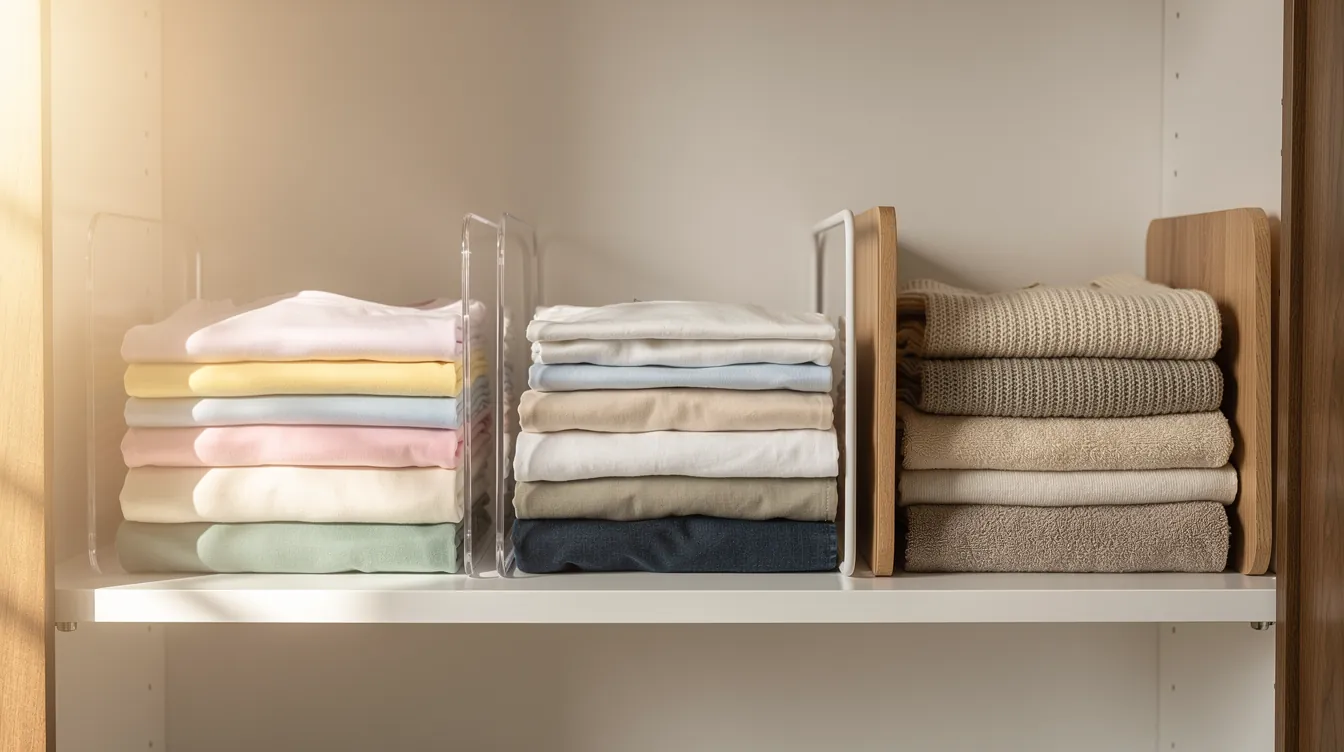
Types of Shelf Dividers: Materials, Styles, and Which to Choose
Shelf dividers come in several materials, each with distinct advantages and drawbacks. Choosing the right material matters — the wrong type can crack, slip, scratch your shelves, or simply not hold up to what you are storing.
Acrylic Shelf Dividers: Pros, Cons, and Best Uses
Acrylic (clear plastic) dividers are the most popular type — and the most photographed. They are transparent, so they disappear visually and let the items on the shelf be the focus. They work beautifully for folded clothes, handbags, and display shelves where you want a clean, minimalist look.
Pros: Invisible aesthetic, easy to clean, lightweight, widely available online in India.
Cons: Thin acrylic (under 4 mm) can crack or break under pressure. Many budget options on Amazon India and Flipkart use thin acrylic that fails after a few months. Sharp corners can also be a problem.
Recommendation: If you choose acrylic, look for a minimum thickness of 5 mm. Avoid the cheapest options — they will not last. Acrylic is best for lightweight items like folded t-shirts, scarves, and handbags, not for heavy stacks of books or cookware.
Metal Shelf Dividers: Pros, Cons, and Best Uses
Metal dividers — typically steel or aluminium with a powder-coated finish — are the strongest option. They handle heavy loads without bending and last for years.
Pros: Maximum strength, no cracking, often more adjustable than acrylic. Best for heavy items: stacked books, cookware, and deep almirah shelves with thick piles of clothes.
Cons: Some budget metal dividers have sharp edges that can scratch wooden shelves. Wire-style dividers may let small items slip through. In coastal humid climates, uncoated metal can rust.
Recommendation: Metal is the best choice for Indian almirahs with deep shelves carrying heavy saree stacks or kurta piles. Look for dividers with silicone grip pads on the base and rounded or coated edges.
Wooden Shelf Dividers: Pros, Cons, and Best Uses
Wooden dividers — typically plywood, MDF, or solid wood — match wooden shelves aesthetically and can be a beautiful addition to visible bookshelves and display areas.
Pros: Best aesthetic match for wooden furniture, can be DIY-friendly, solid and durable when thick enough. No plastic look.
Cons: Heavier and bulkier than acrylic or metal, not adjustable once installed, can warp in humid conditions, typically more expensive than acrylic.
Recommendation: Use wooden dividers on visible bookshelves, living room display units, and anywhere aesthetics matter more than adjustability. Avoid in bathrooms and high-humidity areas unless sealed.
Expandable and Adjustable Dividers: The Flexible Option
Expandable dividers use tension rods, spring-loaded mechanisms, or width-adjustable designs to fit shelves of varying sizes without tools. They are ideal for renters who cannot make permanent changes, or for anyone who frequently reorganizes their space.
Pros: No installation required, fits multiple shelf widths, removable and reusable, great for renters.
Cons: Less stable than fixed dividers, tension-based models can lose grip over time, usually more expensive per divider.
Recommendation: Choose expandable dividers if you rent your home, reorganize frequently, or want a no-commitment solution. For permanent organization in your own home, fixed dividers are more stable and cost-effective.
2026 Trend: Eco-Friendly and Sustainable Divider Materials
Home organization trends in 2026 are shifting toward natural and sustainable materials. Bamboo dividers, recycled acrylic, and plastic-free packaging options are increasingly available. House Digest identified eco-friendly closet organization as a key 2026 trend, with a move away from virgin plastics toward renewable materials. Modular and flexible storage solutions that adapt to changing needs — rather than single-use organizational products — are also gaining ground. When you buy, consider quality over quantity: a well-made set of dividers that lasts five years is better for your home and the planet than budget options you replace every year.
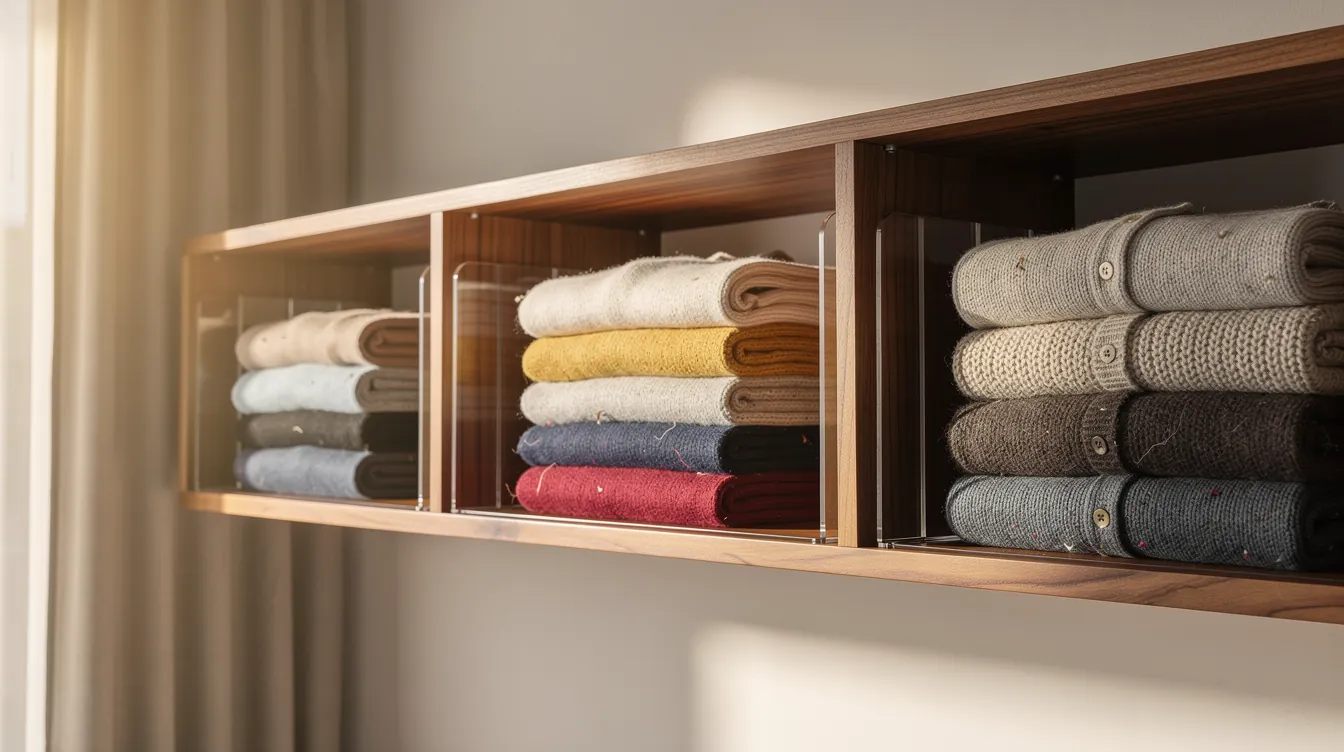
How to Choose the Right Shelf Dividers for Your Space
Choosing the right shelf dividers is not just about picking a material — it is about getting the measurements right, matching the divider to what you store, and avoiding the common mistakes that lead to returns and frustration.
Measuring Your Shelves Correctly (The Step Most People Skip)
This is the number one mistake buyers make: ordering dividers without measuring their shelves first. Here is exactly what to measure:
- Shelf depth: The distance from the front edge of the shelf to the back wall. Most standard dividers are designed for shelves 10–14 inches deep. Indian almirah shelves are often 18–22 inches deep — if you have an Indian cupboard, measure carefully. A divider that is too shallow will leave items at the back unsupported.
- Shelf thickness: How thick is the shelf board itself? Many clamp-on or clip-on dividers are designed for shelves 0.5–1 inch thick. Indian wooden almirah shelves can be 1–1.5 inches thick — if your divider's grip cannot accommodate the thickness, it will not stay in place.
- Shelf height: The vertical space between shelves. This determines the maximum divider height. Leave at least 2–3 inches of clearance above the divider so you can easily lift items in and out.
Measure every shelf you plan to organize individually — shelf dimensions often vary within the same cupboard.
Matching Divider Type to What You Are Storing
| What You Are Storing | Best Divider Material | Why |
|---|---|---|
| Heavy items: books, cookware, thick piles | Metal | Maximum strength, no bending under weight |
| Lightweight clothes: t-shirts, scarves, kids' clothes | Acrylic (5mm+) | Clean look, visibility, sufficient strength |
| Sarees and heavy Indian wear | Metal or thick wood | Deep shelves need strong, tall dividers |
| Handbags and purses | Acrylic | Keeps bags upright and visible without scratching |
| Display items: decor, photo frames | Wood or acrylic | Aesthetic match matters here |
| Kitchen pantry: dal, rice, atta containers | Metal | Handles weight of filled containers |
| Frequent reorganization needed | Expandable/Adjustable | Flexibility without commitment |
5 Mistakes to Avoid When Buying Shelf Dividers
- Not measuring shelf thickness. This is the single most common reason for returns. Many dividers clip onto the shelf edge — if your shelf is thicker than the clip's capacity, the divider is useless.
- Buying non-adjustable dividers for variable loads. Fixed-width dividers work best when you always store the same type of items. If your shelf alternates between thick winter clothes and thin summer clothes, you need adjustable spacing.
- Choosing acrylic for heavy items. Acrylic looks great but has limits. Stacking heavy books or cookware against thin acrylic dividers leads to cracks and breakage within months.
- Ignoring sharp edge risks on metal dividers. Budget metal dividers often arrive with sharp or unfinished edges. These scratch wooden shelves on first use. Always check reviews for edge quality before buying.
- Buying too few dividers. One divider per shelf is rarely enough. Count the number of sections you want — if you want to separate a shelf into 3 zones, you need 2 dividers. For a full wardrobe with 5 shelves, you may need 8–12 dividers. Under-buying means you reorganize incompletely and end up placing a second order.
Shelf Dividers for Indian Wardrobes and Almirahs
This section is the most important one on this page if you live in India. Indian wardrobes and almirahs are built differently from Western closets, and standard shelf divider advice often does not apply. Here is what you need to know specifically for Indian homes.
Why Indian Cupboards Need Different Divider Strategies
Indian almirahs and standalone cupboards have three characteristics that change how shelf dividers work:
- Deeper shelves: Standard Western closet shelves are 12–14 inches deep. Indian almirah shelves are commonly 18–22 inches deep. A divider designed for a 12-inch shelf leaves the back half of your almirah shelf completely unsupported — items at the back will still topple and mix.
- Thicker shelf boards: Many Indian wooden almirahs use solid wood shelves that are 1–1.5 inches thick. Clip-on dividers designed for thin MDF shelves (0.5 inch) will not grip. You need dividers rated for the full thickness of your shelf.
- Different contents: Indian wardrobes store sarees (folded stacks that are wider and heavier than Western clothing), kurtas (longer folded piles), dupattas (lightweight, slippery stacks), and mixed items (clothes, bedding, documents, and miscellaneous items often share a single almirah). Each of these needs a different divider strategy.
Organizing Sarees, Kurtas, and Dupattas with Shelf Dividers
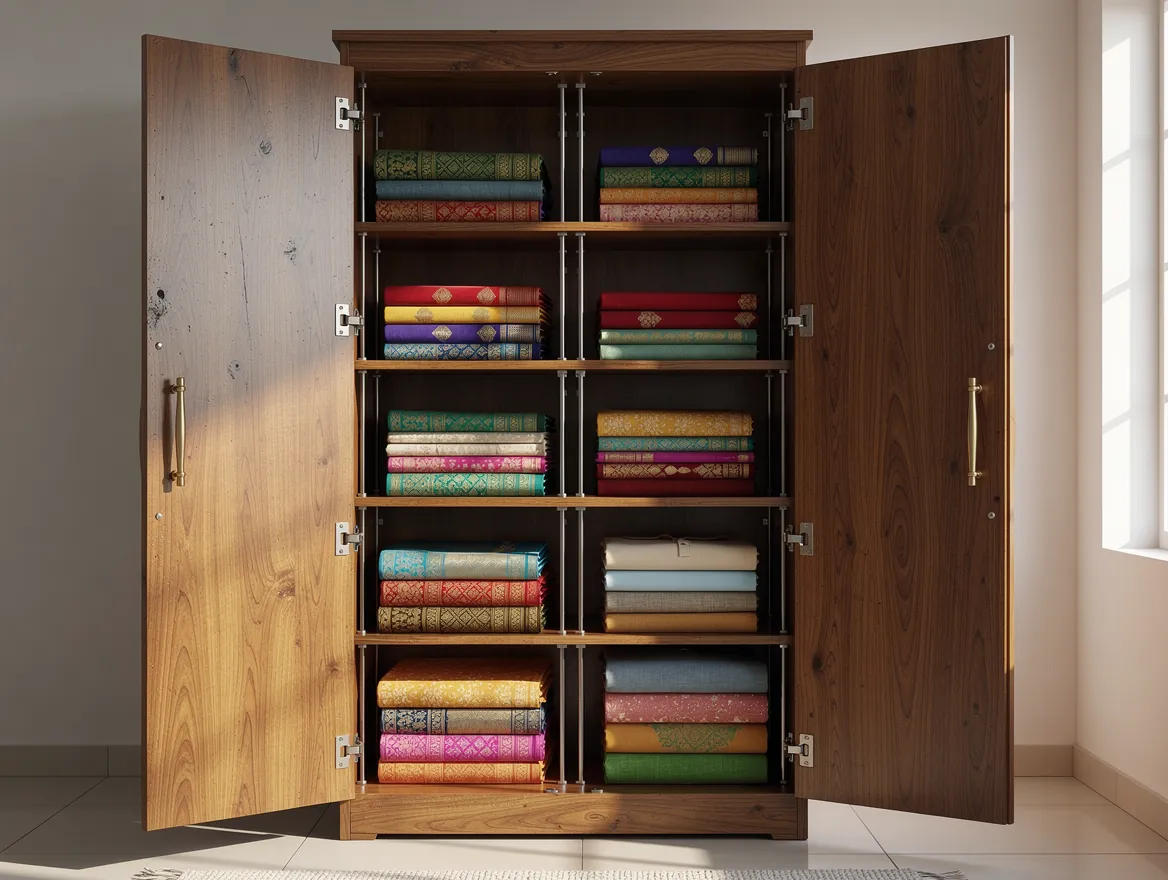
Saree stacks: Folded sarees form wide, heavy stacks. A typical cotton saree stack is 10–12 inches wide. Use metal dividers positioned to create sections that match your saree stack width. Metal is important here because the weight of a full saree stack will bend thin acrylic over time. If your almirah shelf is 20 inches deep, look for extra-deep dividers or position two shorter dividers in sequence (one at the front, one at the back) to create a continuous partition.
Kurta piles: Kurtas fold into taller, narrower piles than sarees. Acrylic dividers work well for kurta stacks if the stacks are light to moderate weight. Create sections wide enough to hold 8–10 folded kurtas without squeezing them — overcrowding causes wrinkles.
Dupatta management: Dupattas are slippery and tend to slide. Use closer divider spacing (6–8 inches apart) so stacks stay put. Acrylic dividers with non-slip base grips work best here since dupatta stacks are light.
Dividers for Mixed-Use Almirahs (Clothes + Bedding + Miscellaneous)
Many Indian almirahs store everything in one unit: clothes on one shelf, bedsheets on another, documents and random items on a third. Shelf dividers can create zones within a single shelf so different categories stay separate:
- Zone 1 (left): everyday clothes, frequently accessed
- Zone 2 (middle): occasional wear or seasonal items
- Zone 3 (right): bedding, towels, or non-clothing items
Use taller dividers (matching the shelf height closely) to prevent items from one zone tumbling into another. For deep almirahs, consider using two dividers per partition gap — one at the front and one halfway back — to maintain separation across the full depth.
DIY Shelf Dividers: Budget-Friendly Options Anyone Can Make
Not ready to invest in readymade shelf dividers? You can make effective dividers at home with basic materials. Here are three approaches, from zero-cost to simple woodworking.
Cardboard and Recycled-Material Shelf Dividers (Zero Cost)
Cardboard dividers are the easiest DIY option and cost nothing if you have spare cardboard boxes. Here is how to make a sturdy cardboard shelf divider:
- Cut two identical rectangles of thick corrugated cardboard to your desired divider dimensions — the width should match your shelf depth, and the height should be slightly less than the space between shelves.
- Glue the two pieces together with strong adhesive (Fevicol or hot glue) for double thickness — single-layer cardboard will buckle.
- Cover the divider with adhesive vinyl wrap, contact paper, or even decorative washi tape to protect against moisture and give it a clean look.
- To keep it standing, attach a small right-angle cardboard bracket at the base or wedge the divider between items on the shelf.
Cardboard dividers work best for lightweight items like t-shirts, kids' clothes, and linens. They are not suitable for heavy books, cookware, or humid environments (bathrooms, kitchens). Expect to replace them every 6–12 months.
Simple Wooden Shelf Dividers You Can Build at Home
If you have basic tools and can visit a local hardware shop, wooden dividers are a step up in durability:
- Materials: 8–12 mm plywood or MDF sheet cut to size. Most hardware shops in Bangalore (SP Road, local timber yards) will cut sheets to your exact dimensions for a small charge.
- Tools needed: Sandpaper (to smooth edges), wood glue or small L-brackets, optional paint or varnish.
- Construction: Cut the plywood to size, sand all edges thoroughly, apply a coat of varnish or paint to seal against moisture, and use L-brackets to attach the divider to the shelf or simply wedge it in place with non-slip pads underneath.
- Cost estimate: Rs. 150–300 per divider, depending on plywood quality and finish — compared to Rs. 400–800 for a comparable readymade acrylic divider online.
When DIY Makes Sense (and When to Call a Professional)
DIY shelf dividers are a great choice when:
- You only need 1–2 dividers on standard-sized shelves.
- You enjoy hands-on projects and have the time.
- Your shelves have unusual dimensions that standard readymade dividers do not fit.
DIY may not be the right choice when:
- You need to organize an entire home across multiple rooms and cupboard types.
- Your shelves are deep Indian almirah shelves requiring custom sizing and strong materials.
- You have tried organizing before and the results did not last.
- You simply do not have the time or energy for a DIY project.
If you are in the latter camp, Tidy Blueprints' professional organizers handle everything — measuring, sourcing the right dividers, installation, and styling — so you walk into a fully organized home without lifting a finger.

Shelf Dividers Room by Room: Where to Use Them
Shelf dividers are not just for wardrobes. Here is how they work in every room of the home.
Wardrobe and Closet Shelf Dividers
This is the most common use case. Use dividers to separate t-shirts from jeans, handbags from folded sweaters, and everyday clothes from occasional wear. For shared wardrobes, dividers create clear boundaries between two people's items on the same shelf. Use acrylic for visibility when you want to see what is on each shelf at a glance.
Kitchen and Pantry Shelf Dividers
Indian kitchens benefit enormously from shelf dividers. Separate stacks of steel plates by size, create sections for different dal and rice containers, divide spice bottles into cooking vs. finishing spices, and keep lids matched with their containers. In the pantry, dividers prevent atta, rice, and dal containers from mixing on deep shelves. Choose metal dividers for kitchen use — they handle weight and humidity better than acrylic or wood.
Bookshelf and Display Shelf Dividers
On open bookshelves, dividers separate fiction from non-fiction, create visual breathing room between book sections, and let you combine books with decor items without everything blending together. Wooden dividers look best here — they match the bookshelf material and feel intentional. For IKEA BILLY and KALLAX shelves (popular in Indian homes), standard-width dividers usually fit without modification.
Kids' Room and Nursery Shelf Dividers
Kids' shelves collect everything: toys, books, clothes, art supplies, and more. Dividers create sections that children can understand and maintain — a section for soft toys, one for board books, one for building blocks. Use rounded-edge acrylic or wood dividers (no sharp metal edges in a child's room). The organization also teaches kids to put things back where they belong.
Bathroom and Utility Shelf Dividers
In bathrooms and utility areas, dividers keep towels stacked neatly, separate cleaning supplies from personal care items, and prevent bottles from toppling. Important: avoid unfinished wood in humid bathrooms — it will warp. Use acrylic, coated metal, or sealed wood only.
Common Shelf Divider Problems and How to Fix Them
Based on real customer reviews across Indian ecommerce platforms, here are the most frequent frustrations with shelf dividers — and how to avoid or fix each one.
Dividers That Slip, Slide, or Fall Over
Why it happens: The shelf is not fully loaded (light items do not provide enough lateral pressure), the divider's grip mechanism is wrong for your shelf material, or the divider base has no anti-slip feature.
How to fix it:
- Add non-slip silicone pads to the base of any divider. These are available on Amazon India for under Rs. 200 for a pack of 20+.
- For clamp-on dividers, confirm the clamp fits your shelf thickness — many are designed for thin MDF and fail on thick wooden almirah shelves.
- Load shelves properly: items on either side of the divider should be tall enough to provide lateral support. If one side is near-empty, the divider will tip toward the empty side.
- Consider L-bracket reinforcement for permanent installations — a small bracket screwed into the shelf behind the divider holds it in place invisibly.
Cracked or Broken Acrylic Dividers
Why it happens: Thin acrylic (under 4 mm) cannot handle lateral pressure from heavy items. Cracks usually start at stress points — near the base, at corners, or where the divider meets the shelf edge.
How to fix it:
- Prevention is the only real fix: buy acrylic dividers that are at least 5 mm thick. Check the product specifications before ordering — many listings hide the thickness in the fine print.
- For heavy items (books, cookware, thick saree stacks), switch to metal dividers instead of acrylic.
- Inspect dividers immediately on delivery. If the acrylic feels flimsy or flexes easily, return it. Indian ecommerce return windows are typically 7–10 days — do not wait to test.
Humidity and Climate Considerations for Indian Homes
India's climate varies dramatically, and it affects shelf divider performance:
- Coastal humidity (Mumbai, Chennai, Kolkata, Kochi): Adhesive-based dividers lose grip as humidity weakens the adhesive. Metal dividers without proper coating can rust. Wood can warp. Use powder-coated metal or thick acrylic with mechanical grip (not adhesive). Avoid unsealed wood entirely.
- Monsoon season (June–September, pan-India): Even inland cities like Bangalore experience high humidity during monsoons. Wooden shelves and dividers can swell slightly, changing the fit. Leave a small tolerance (1–2 mm) when cutting DIY wood dividers to account for seasonal expansion.
- Dry heat (Delhi, Rajasthan, interior Karnataka): Wood can crack in prolonged dry heat. Sealed and varnished wood holds up better than raw wood. Acrylic and metal are largely unaffected by dry conditions.
Professional Shelf Organization vs. DIY: Which Is Right for You?
You have now read an entire guide on shelf dividers — what they are, how to choose them, where to use them, and how to avoid common problems. At this point, you have two paths: do it yourself, or get professional help. Here is how to decide.
What a Professional Organizer Actually Does with Shelf Dividers
When you hire Tidy Blueprints for shelf organization, here is what actually happens:
- Assessment: A trained organizer visits your home in Bangalore, inspects every cupboard, almirah, and shelf you want organized, and understands how you use each space.
- Measuring: Every shelf is measured — depth, thickness, height, and usable width. This eliminates the measurement guesswork that leads to wrong-sized dividers.
- Recommendation: Based on what you store (sarees, kurtas, books, kitchenware, kids' toys), the organizer recommends the right divider type, material, and quantity for each shelf. You get a clear plan before anything is bought.
- Procurement: Tidy Blueprints sources the dividers — selecting quality products with the right specifications, avoiding the thin acrylic and sharp-edge metal problems described earlier in this guide.
- Installation and styling: The organizer installs every divider, arranges your items into the new sections, and styles the space so it looks as good as it functions. You walk into a fully organized home — no measuring, no shopping, no installation, no frustration.
Cost Comparison: DIY vs. Professional Organization
| DIY Approach | Professional (Tidy Blueprints) | |
|---|---|---|
| Divider cost | Rs. 150–800 per divider depending on material and quality | Included in service — organizers bring the right products |
| Time investment | 2–4 hours measuring + 1–2 hours shopping + 2–4 hours installing = 5–10 hours total | Zero — you are not involved in the process |
| Risk of wrong purchase | High — returns and reorders are common | Zero — the organizer gets it right the first time |
| Result longevity | Depends on your skill and product choices | Guaranteed — professional installation with quality products lasts years |
| Overall experience | Potentially satisfying if you enjoy DIY; frustrating if you do not | Effortless — you book the appointment, we handle everything |
For a single shelf in a standard cupboard, DIY makes financial sense. For a whole home — multiple wardrobes, kitchen shelves, bookshelves, kids' rooms — the time, effort, and risk of wrong purchases tilt the equation toward professional help.
When to Book a Professional Organizer in Bangalore
You should consider booking Tidy Blueprints if:
- You have recently moved to a new home and want to start organized from day one.
- You have completed a home renovation and the cupboards are empty but disorganized.
- You have tried organizing on your own and the results did not last more than a few weeks.
- Your almirahs are deep Indian-style cupboards that need custom divider solutions.
- You simply want a beautifully organized home without spending your weekends measuring shelves and browsing Amazon.
Tidy Blueprints serves all of Bangalore — from Sarjapur Road to Indiranagar, Koramangala, Whitefield, and beyond. Book a free online consultation to discuss your space, or call us at +91-636 220 1675 with any questions.
Frequently Asked Questions About Shelf Dividers
What are shelf dividers used for?
Shelf dividers create vertical partitions on shelves to separate and organize items. They prevent stacked clothes from toppling, keep handbags upright, separate books by category, organize kitchenware, and create defined zones on any shelf. They are used in wardrobes, kitchens, bookshelves, kids' rooms, and bathrooms.
Which material is best for shelf dividers — acrylic, metal, or wood?
It depends on what you are storing. Acrylic (5 mm+ thickness) is best for lightweight clothes and handbags where visibility matters. Metal is best for heavy items like books, cookware, and thick saree stacks — it is the strongest option. Wood is best for visible bookshelves and display areas where aesthetics matter. Avoid thin acrylic (under 4 mm) as it cracks easily.
How do I measure my shelves for dividers?
Measure three things: (1) shelf depth — the distance from front edge to back wall, (2) shelf thickness — how thick the board is (important for clamp-on dividers), and (3) shelf height — the vertical space between shelves. Indian almirah shelves are often 18–22 inches deep, which is deeper than standard Western shelves, so measure carefully before buying.
Can I use shelf dividers in an Indian almirah with deep shelves?
Yes, but you need dividers rated for deep shelves. Standard dividers designed for 12-inch shelves leave the back half of an Indian almirah unsupported. Look for extra-deep dividers, or use two dividers in sequence (one at the front, one further back) to create a continuous partition across the full depth. Metal dividers work best for the heavy loads common in Indian almirahs.
Do shelf dividers work without drilling or permanent installation?
Yes. Most shelf dividers use clamp-on, tension-rod, or freestanding designs that require no tools or permanent changes. Expandable spring-loaded dividers are ideal for renters. Some dividers use silicone grip pads on the base and stay in place through friction and the weight of items on either side. For maximum stability on thick wooden almirah shelves, look for dividers with adjustable clamps rated for your shelf thickness.
How many shelf dividers do I need for one cupboard?
Count the number of sections you want minus one. For example, if you want to divide one shelf into 3 zones, you need 2 dividers. A typical 3-shelf wardrobe might need 6–9 dividers total. Buy all the dividers you need in one order — under-buying means incomplete organization and a second round of shopping. If you are unsure, a professional organizer can assess and recommend the exact count.
How do I stop shelf dividers from slipping or falling over?
Common fixes include: adding non-slip silicone pads to the divider base (available on Amazon India for under Rs. 200), ensuring both sides of the divider are loaded with items tall enough to provide lateral support, checking that clamp-on dividers are rated for your shelf thickness, and using small L-brackets for permanent installations. Adhesive-based dividers often fail in humid Indian conditions — choose mechanical grip designs instead.
Are professional shelf organization services worth it compared to buying dividers myself?
For a single shelf, DIY makes financial sense. For a whole home — multiple wardrobes, kitchen shelves, bookshelves, and kids' rooms — professional services save time, eliminate the risk of wrong purchases, and deliver a guaranteed result. A professional organizer measures everything, sources the right products, installs them correctly, and styles the space. In Bangalore, Tidy Blueprints offers this as an end-to-end service — you get an organized home without the measuring, shopping, and installation effort.
Key Takeaways
The most important things to remember when organizing your shelves with dividers.
Measure Everything Before You Buy
Shelf depth, thickness, and height all matter. Indian almirahs have deeper and thicker shelves than Western cupboards — standard-sized dividers often do not fit. Measure every shelf individually before ordering.
Read the measuring guideIndian Homes Need Different Solutions
Deep almirah shelves, saree stacks, kurta piles, and mixed-use cupboards require divider strategies that Western-focused guides do not cover. Choose materials and sizes specifically for the Indian home context.
Explore Indian wardrobe guidanceDIY Is Great for a Shelf — Professional Help for a Home
Making your own dividers works well for 1–2 standard shelves. For whole-home organization across multiple rooms, a professional organizer saves you time, eliminates wrong purchases, and delivers a result that lasts.
DIY vs professional comparisonReady for a Professionally Organized Home?
Tidy Blueprints handles everything — measuring, product selection, installation, and styling. Serving all of Bangalore, from Sarjapur Road to Whitefield. Book a free online consultation to discuss your space.
Book a Free Online ConsultationWant a Professionally Organized Home Without the Effort?
Skip the measuring, shopping, and installation. Tidy Blueprints' professional organizers handle everything — from assessing your space to sourcing the right shelf dividers to styling every shelf beautifully. Serving homes across Bangalore.