Kitchen Organiser Stand: Types, Materials & Buying Guide
Your complete guide to types, materials, and buying decisions — from countertop racks to wall-mounted shelves, tailored for Indian kitchens.
Jump to section
What Is a Kitchen Organiser Stand?
A kitchen organiser stand is a storage unit designed to keep your kitchen essentials — utensils, spice containers, dishes, and cookware — neatly arranged and easily accessible. Unlike closed cabinets that hide everything behind doors, an organiser stand puts frequently used items within arm's reach, turning chaotic countertops into functional workspaces.
Types of Kitchen Organiser Stands
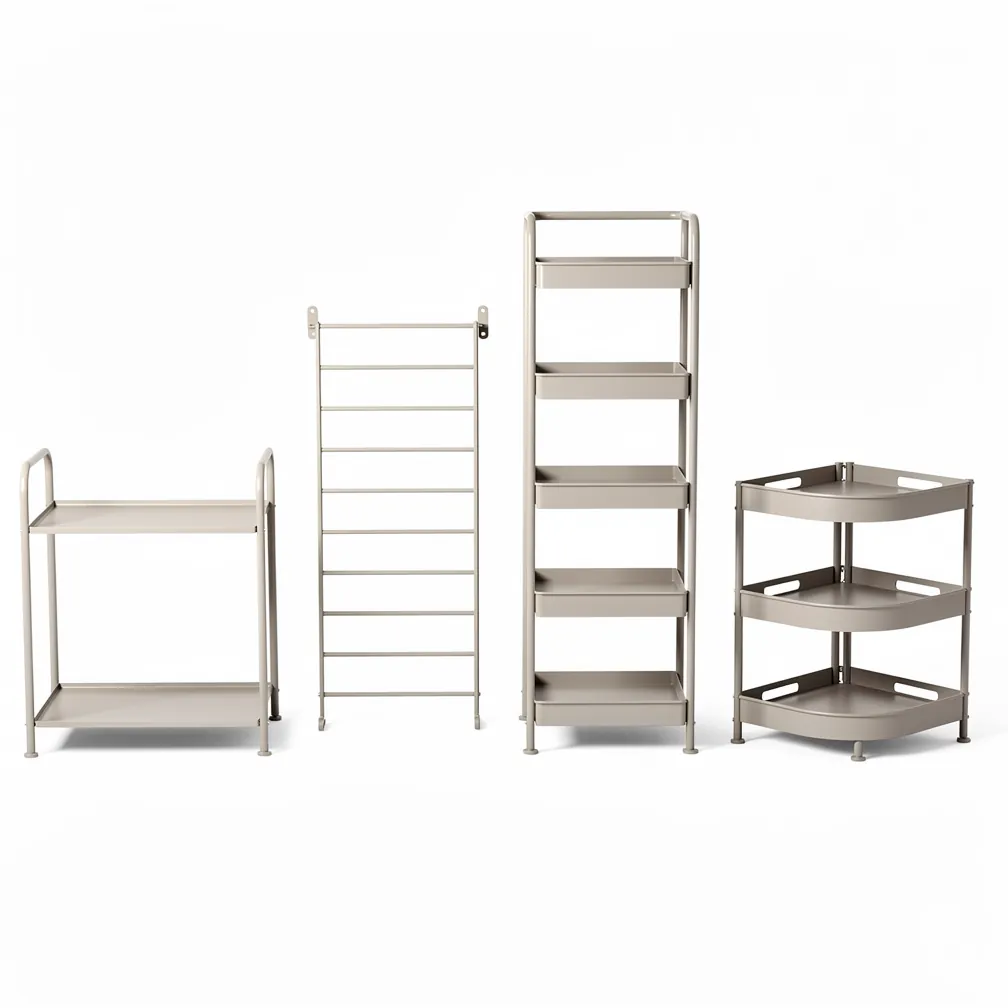
Kitchen organiser stands come in several form factors, each suited to different kitchen layouts and storage needs:
- Countertop Tiered Stands — Multi-level racks that sit directly on your kitchen counter. These are ideal for storing masala dabbas, spice jars, and small containers. In Indian kitchens, a 2-3 tier stand near the cooking hob keeps everyday spices instantly accessible while freeing up counter space below.
- Wall-Mounted Racks and Shelves — Fixed to the wall above the counter or sink, these save valuable counter space. Wall-mounted stands work well for utensil storage, dish drying, and frequently used cookware. They're especially useful in galley kitchens common in Bangalore apartments, where every inch of wall real estate matters.
- Freestanding Floor Stands — Tall, multi-tier units that stand on the floor, often with wheels for mobility. These work well in larger kitchens or utility areas for storing pressure cookers, large kadai, bulk groceries, and less frequently used appliances.
- Corner Stands — Designed to fit into kitchen corners, which are otherwise dead space. Corner stands help utilise awkward angles, making them perfect for small kitchens where every square foot counts.
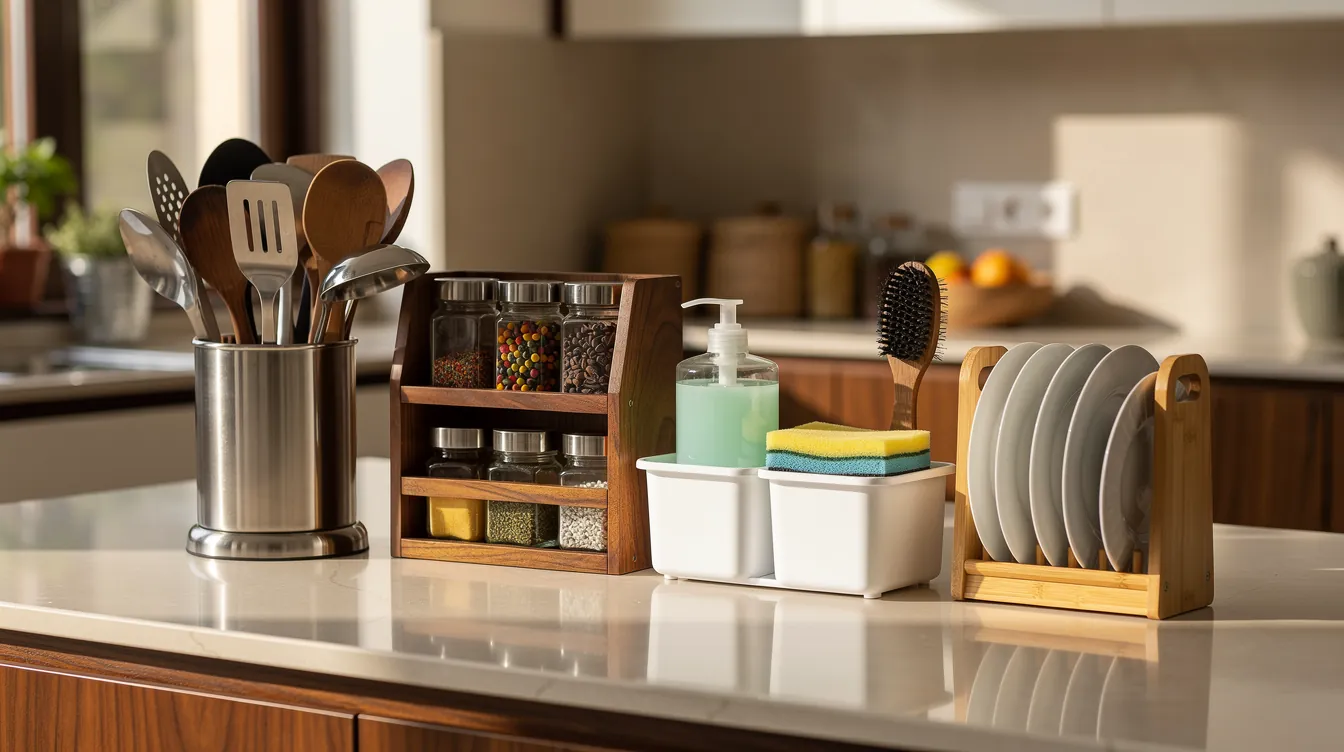
- Specialty Stands — Purpose-built for specific Indian kitchen needs: masala racks with small jars, dish-drying racks with drip trays, bartan (utensil) stands with angled shelves, and thali holders. These address storage challenges that generic organisers often miss.
Countertop vs. Wall-Mounted vs. Freestanding Stands
Choosing the right mounting type is your first and most important decision:
Countertop Stands: Best for renters and those who want flexibility. No installation needed. Ideal for spices, small jars, and frequently used items. Limitation: They use up precious counter space — a concern in compact Indian kitchens where counters often double as prep surfaces.
Wall-Mounted Stands: Best for maximising floor and counter space. Great for utensil storage, dish racks, and spice shelves. Limitation: Require drilling into walls — a problem in rented apartments unless you get landlord approval or use damage-free mounting options.
Freestanding Floor Stands: Best for heavy-duty storage of large cookware — pressure cookers, kadai, tawa. Many come with wheels for easy movement. Limitation: Need floor space, which is scarce in apartment kitchens.
Quick decision rule: If you rent, start with countertop or freestanding options. If you own your home and have limited counters, go wall-mounted. If you cook for a large family with heavy utensils, invest in a sturdy freestanding floor stand.
Why Your Kitchen Needs an Organiser Stand
The Hidden Cost of Kitchen Clutter
If your kitchen counter is a battlefield of scattered spice jars, precariously stacked utensils, and cookware you can never find when you need it — you're not alone. Research tells a sobering story.
Only 1 in 3 people are actually happy with their kitchens, according to a global IKEA study. Meanwhile, kitchen clutter is linked to stress and anxiety in over half of homeowners. And 73% of people avoid showing guests parts of their homes — with the kitchen being one of the top hiding spots.
The costs extend beyond frustration. Kitchen clutter leads to:
- Duplicate purchases — buying masala or groceries you already have because you couldn't find them in the mess.
- Wasted time — minutes lost daily searching for the right lid, the specific spice jar, or that one kadai buried at the back.
- Food waste — disorganised pantries where items expire unnoticed behind newer purchases.
- Reduced cooking joy — when cooking feels like a chore because you're fighting your own kitchen, you cook less. And when you cook less, you eat out more — a real cost for Indian households where home cooking is central to daily life.
How a Stand Transforms Your Daily Cooking Routine
Imagine walking into your kitchen and finding everything in its place. Your masala dabba sits on its designated tier, each compartment labelled and facing forward. Your pressure cooker, kadai, and tawa each have their spot — no stacking, no rummaging, no avalanche of lids when you reach for the back.
An organiser stand transforms the kitchen in three ways:
Speed — Cooking Indian meals often involves coordinating multiple dishes simultaneously: dal on one burner, sabzi on another, rotis rolling out, and rice steaming away. When every tool and spice is instantly accessible, you move through your cooking sequence without breaking flow. No more "where did I put the haldi?" interruptions while the tadka is burning.
Safety — Cluttered counters increase the risk of knocking hot vessels or sharp utensils off the edge. A well-organised stand keeps everything stable and within a defined zone, reducing accidents — especially important in households with children or elderly family members.
Space creation — Counterintuitively, adding an organiser stand often creates more usable space. By stacking vertically and defining zones, you consolidate scattered items into a compact footprint, freeing up the surrounding counter for actual food preparation.
In Bangalore, where the professional organising industry has seen a 3x increase in demand — from 5-6 homes per month to 3-4 homes per week, according to the Deccan Herald — more families are recognising that an organised kitchen isn't a luxury. It's a daily quality-of-life upgrade that pays for itself in saved time, reduced waste, and the simple joy of cooking in a space that works with you, not against you.
How to Choose the Right Kitchen Organiser Stand
Choosing the right organiser stand isn't just about picking the one that looks good in product photos. A stand that doesn't fit your space, can't handle your utensils' weight, or rusts within six months of Bangalore's monsoon is money wasted. Here's how to get it right the first time.
Measuring Your Space: The Number One Mistake to Avoid
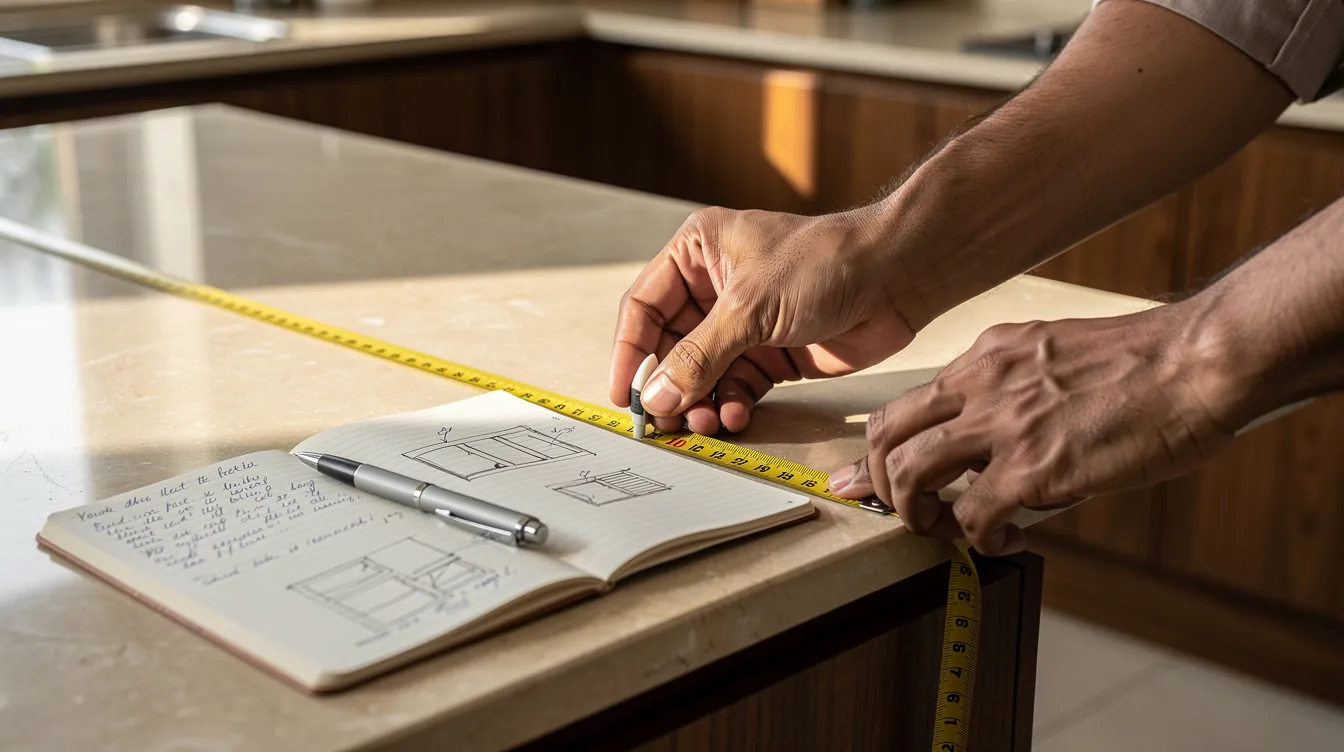
The single most common complaint in Amazon India reviews? "Didn't fit." Stands arrive too tall for the space under cabinets, too wide for the counter depth, or too small for the utensils they were bought for. Avoid this with a simple pre-purchase measurement routine:
- Countertop depth: Measure from the wall to the counter's front edge. Subtract 2-3 inches for comfortable workspace in front of the stand. Your stand's depth should not exceed this measurement.
- Height clearance: Measure from the countertop to the bottom of any wall cabinets above. Your stand's total height needs at least 1-2 inches of clearance below cabinets so you can reach items on the top tier.
- Wall space width: For wall-mounted stands, measure the available wall width between cabinets, windows, or appliances. Leave at least 4-6 inches of clearance on each side for visual breathing room.
- Utensil dimensions: Measure the diameter of your largest kadai and the height of your tallest pressure cooker. If the stand's shelf spacing can't accommodate these, it's the wrong stand.
Pre-purchase checklist (fill this out before shopping):
- Available counter depth: ___ inches/cm
- Height under cabinets: ___ inches/cm
- Available wall width (if wall-mounted): ___ inches/cm
- Largest utensil diameter: ___ inches/cm
- Heaviest item weight: ___ kg
Material Comparison: Stainless Steel vs. Wood vs. Plastic vs. Metal Alloys
Material choice affects durability, maintenance, appearance, and price. Here's how the four main options stack up for Indian kitchens:
Stainless Steel (304 Grade)
- Best for: Wet areas, near-sink placement, heavy Indian utensils
- Rust resistance: Excellent — 304-grade SS resists corrosion even in humid coastal conditions
- Weight capacity: High — 20-50 kg depending on gauge thickness
- Maintenance: Easy — wipe with damp cloth; vinegar removes hard water spots
- Price range: Rs. 800-4,000
- Watch for: Lower-grade "stainless steel" (202 grade) that rusts within months. Check for "SS 304" marking. A magnet test helps — 304-grade is less magnetic than 202.
Wood (Sheesham, Mango, Engineered Wood)
- Best for: Dry storage, open shelving, aesthetic display, spice racks
- Rust resistance: Not applicable — but susceptible to moisture warping and termite damage
- Weight capacity: Moderate — 10-25 kg depending on wood type and joinery
- Maintenance: Moderate — oil quarterly; avoid soaking; wipe spills immediately
- Price range: Rs. 1,200-6,000
- Watch for: Engineered wood (MDF/particle board) swells and disintegrates with moisture. Solid wood costs more but lasts decades. Choose sheesham or mango wood for Indian climate durability.
Plastic / Acrylic
- Best for: Budget setups, lightweight items, temporary/rental use
- Rust resistance: Excellent — completely rust-proof
- Weight capacity: Low — 5-10 kg; not suitable for heavy cookware
- Maintenance: Easy — mild detergent wash; avoid abrasive scrubbers that scratch
- Price range: Rs. 300-1,200
- Watch for: UV degradation — plastic yellows and becomes brittle in direct sunlight. Not suitable near windows or open balconies.
Metal Alloys (Powder-Coated Iron, Aluminium)
- Best for: Heavy-duty storage, pantry shelving, utility areas
- Rust resistance: Moderate — powder coating protects but chips expose bare metal. Aluminium doesn't rust but is less rigid.
- Weight capacity: Very high — 30-60 kg for heavy-gauge iron
- Maintenance: Moderate — inspect for coating chips monthly; spot-treat exposed metal with anti-rust paint
- Price range: Rs. 1,500-5,000
- Watch for: "Scratch-and-rust" cycle — once the coating chips, rust spreads under the surrounding coating. Choose stands with thick, evenly applied powder coating.
Weight Capacity and Stability: What to Look For
Indian stainless steel utensils are heavier than most Western cookware. A full pressure cooker, a cast-iron tawa, and a set of brass thalis can easily exceed 15 kg on a single shelf. If the stand wobbles, it's a safety hazard — especially in households with children.
How to assess stability and capacity:
- Check the base design: Wide, flat bases with rubberised feet resist tipping. Narrow, pedestal-style bases are inherently unstable — avoid them for anything above countertop height.
- Look for cross-bracing: Multi-tier stands should have diagonal or horizontal cross-bars connecting the legs. Without bracing, the stand will sway under load.
- Verify material gauge: Thicker metal = more weight capacity. For stainless steel, look for at least 1.0 mm gauge on the frame. Thin, flimsy tubing (0.5-0.7 mm) will bend under the weight of a loaded pressure cooker.
- Read the weight rating: Reputable brands list per-shelf and total weight capacity. As a rule of thumb, the "advertised" capacity is usually 30-40% higher than real-world safe capacity. Buy a stand rated for at least 30% more than you plan to load.
Style and Aesthetic: Matching Your Kitchen Decor
An organiser stand sits in plain sight — it should complement your kitchen, not clash with it. Consider:
- Modern modular kitchens (laminate/acrylic finishes): Sleek stainless steel or chrome-plated stands with clean lines. Avoid ornate wooden stands that look out of place.
- Traditional Indian kitchens (wood cabinets, granite counters): Wooden stands in sheesham or mango wood harmonise with warm-toned interiors. Brass or copper-finish accents on metal stands add character.
- Mixed-material kitchens: Black powder-coated metal stands bridge modern and traditional elements well. They're also forgiving of oil splatter and cooking residue.
- Colour tip: In small kitchens, choose stands in lighter finishes (silver, white, light wood) — dark stands visually shrink the space further.
Kitchen Organiser Stand Trends for 2026
Kitchen organisation is evolving fast. The NKBA's 2026 Kitchen Trends Report confirms that storage optimisation, hidden organisation, and multi-functional design are leading priorities for homeowners worldwide. Here's what's shaping the Indian market this year.
Space-Saving Designs for Indian Kitchens
Small kitchens are the norm in Indian cities — Bangalore apartment galley kitchens average just 50-80 square feet. The 2026 trends respond directly to this constraint with designs that maximise every vertical inch:
- Vertical stacking stands — Tall, narrow-profile stands that use height rather than width. Perfect alongside the cooking hob, these keep essentials within reach without eating into limited prep space.
- Over-sink stands — Expandable racks that sit across the sink, turning dead air space into a drying area or temporary prep station. When not in use, they fold and store flat against the wall.
- Corner utilisation stands — L-shaped and triangular stands designed specifically for the wasted corner spaces between counters and walls. These turn dead zones into accessible storage.
- Magnetic wall strips and rails — While not "stands" in the traditional sense, magnetic knife strips, hanging rail systems, and pegboard-style organisers are gaining popularity in Indian modular kitchens. They use zero counter space and keep frequently used tools visible.
Bangalore's kitchen design trends from Livspace, DesignCafe, and HomeLane all point in the same direction: tall kitchen units, pull-out organisers, and vertical storage are no longer premium add-ons — they're becoming baseline expectations for new kitchens.
Multi-Functional and Modular Stands
The second major 2026 trend is flexibility. Instead of buying five single-purpose organisers, homeowners are investing in one system that adapts:
- Stands with built-in cutting boards — The top shelf doubles as a prep surface. Pull it out, chop, and slide it back — zero additional counter space needed. Some even include a removable waste chute for vegetable peels.
- Convertible dish drying racks — A dish rack that becomes storage once the dishes are dry. Simply swap the drip tray for a solid shelf, and the same unit transitions from drying to long-term storage.
- Modular systems — Interlocking components (shelves, hooks, baskets, rails) that can be reconfigured as your needs change. Add more tiers when you buy new cookware. Remove a shelf to accommodate a taller appliance. This modularity is especially valuable in Indian homes where kitchen needs shift with seasons (festival cooking, weekend meal prep, daily roti-sabzi routine).
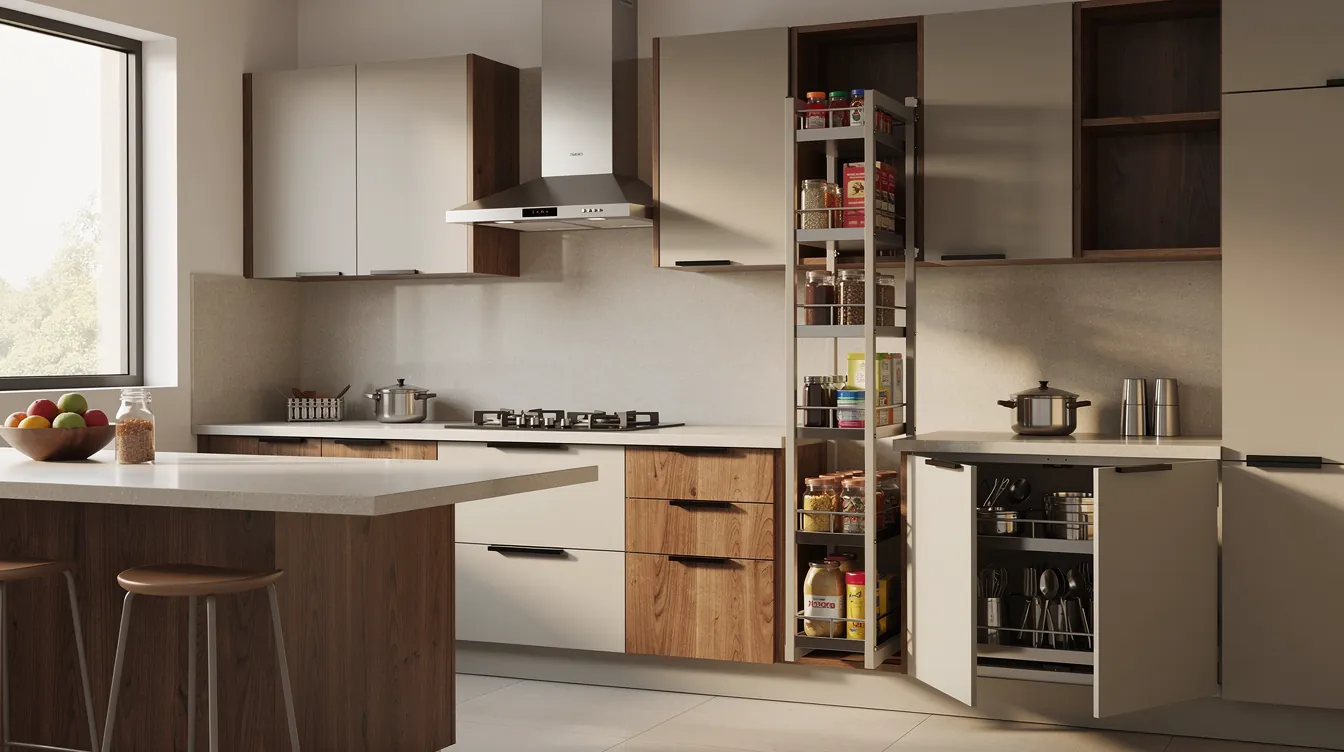
- Hidden storage organisers — Pull-out stands that mount inside existing cabinets. When closed, the kitchen looks minimal and clean. When open, everything is instantly accessible at eye level. The NKBA report notes that four in five homeowners now request hidden storage features in kitchen renovations.
The message is clear: in 2026, a kitchen organiser stand should work harder than just holding things. It should adapt, transform, and earn its footprint.
Common Kitchen Organiser Stand Mistakes (And How to Avoid Them)
Even the best organiser stand becomes a frustration if you pick the wrong one for your situation. Here are the three most common mistakes — and exactly how to avoid them.
Buying Without Measuring First
It sounds obvious, but Amazon India reviews are full of buyers who received a stand that didn't fit. Common scenarios:
- Too tall for under-cabinet placement: The stand arrived and sat 2 inches above the bottom of the wall cabinet, making it impossible to reach the top shelf without removing it entirely.
- Too wide for the counter depth: The stand overhung the counter edge by 3 inches, creating a tipping hazard and blocking drawers below.
- Too small for intended utensils: The shelves were spaced 6 inches apart, but the pressure cooker was 8 inches tall. It didn't fit on any tier.
How to avoid it: Before you browse a single product, complete the measurement checklist from the "How to Choose" section above. Measure twice, buy once. And if you're unsure, Tidy Blueprints offers professional kitchen assessments in Bangalore where we measure, evaluate, and recommend the right stand for your exact kitchen layout.
Choosing the Wrong Material for Your Climate
India's climate varies dramatically — coastal humidity in Mumbai and Chennai, dry heat in Delhi and Rajasthan, and monsoon-heavy conditions in Bangalore and Kerala. The material that works in one region may fail in another.
The "stainless steel" trap: Not all stainless steel is created equal. 202-grade SS (commonly used in budget stands under Rs. 1,000) contains less nickel and chromium than 304-grade. In Bangalore's monsoon season or coastal humidity, 202-grade develops rust spots within 3-6 months. Look for products that explicitly state "304-grade stainless steel" or perform the magnet test — 304-grade is noticeably less magnetic than 202.
The coating chipping cycle: Powder-coated metal stands look great out of the box, but once the coating chips (often during assembly), rust begins at the exposed spot. Within months, the rust spreads under the surrounding coating, peeling it off in sheets. Choose stands with thick, oven-cured powder coating. If a coating looks thin, glossy, or "painted on," skip it.
Wood and moisture: Wooden stands look beautiful but are unforgiving in humid kitchens. MDF and particle board swell, warp, and disintegrate when exposed to steam from cooking. Solid wood (sheesham, mango) fares better but still needs quarterly oiling and immediate wipe-down of spills. In wet-area placements (near the sink), stick to 304-grade stainless steel — it's the only material that reliably handles constant moisture.
Overlooking Installation and Rental Constraints
Bangalore has one of India's largest rental populations — IT professionals, young families, and students who may move every 1-2 years. If you're renting, a wall-mounted stand that requires drilling is not just impractical — it could cost you your security deposit.
What to check before installing:
- Read your rental agreement: Many explicitly prohibit structural modifications including wall drilling. Getting permission in writing from your landlord avoids disputes during move-out.
- Damage-free alternatives: Tension-rod systems that brace between counter and ceiling require zero drilling. Over-door hooks and racks use existing door frames. Suction-cup mounts work on smooth tile backsplashes. Command-strip-style adhesive hooks handle lightweight items. For heavy-duty needs, freestanding floor stands with wheels offer full capacity with zero wall impact.
- Patching if you do drill: If your landlord approves drilling, budget for wall repair before moving out. Wall putty, matching paint, and a weekend of DIY can recover your deposit. Factor this into the "cost" of choosing a wall-mounted stand.
The smartest approach for renters: start with a freestanding tiered stand or over-sink rack. They offer 80% of the organisation benefit with zero installation risk. Upgrade to wall-mounted when you move into your own home.
Why a Professional Organizer's Approach Is Different
Every product retailer — from IKEA to Amazon — wants you to buy an organiser stand. Their incentive is simple: the more you buy, the better it is for them, whether or not the product actually solves your kitchen's problems.
Tidy Blueprints has a fundamentally different approach. As Bangalore-based professional home organisers, our job is to solve your kitchen's storage problems — not to sell you a specific product. Here's what that looks like in practice.
How Tidy Blueprints Assesses Your Kitchen Before Recommending a Stand
When you browse online, you're guessing. You look at product photos shot in studio lighting, read dimensions that may or may not match your space, and hope the material descriptions are accurate. If it doesn't work out, you're stuck with returns, refunds, and starting over.
Our assessment process replaces guessing with data:
Space evaluation — We measure every relevant dimension: counter depth, under-cabinet clearance, wall width, corner angles, and floor space. We photograph the kitchen from every angle so you can see exactly where a stand would go and how it would interact with your existing layout.
Usage pattern analysis — We watch how you cook. Which spices do you reach for most often? Where does the pressure cooker live? Do you prep on the left or right of the hob? This reveals the natural workflow that your organiser stand should support — rather than forcing you to reorganise your habits around a product.
Bottleneck identification — We pinpoint exactly where your kitchen breaks down: the pile of lids with no home, the masala zone that's always a mess, the corner cabinet where things go to disappear. The organiser stand recommendation targets these specific pain points.
Custom recommendation — Based on all three inputs, we recommend the specific type, size, material, and placement of organiser stand that will actually solve your problems. Sometimes the answer is one stand. Sometimes it's a combination. And sometimes, after decluttering, you realise you need less storage than you thought — a conclusion no product retailer will ever help you reach.
Beyond the Stand: Creating a Complete Kitchen Organisation System
An organiser stand is one tool in a larger system. Without zone-based planning and sustainable maintenance routines, even the best stand becomes just another surface that accumulates clutter.
Tidy Blueprints' complete kitchen organisation methodology:
Declutter first, organise second — The non-negotiable first step. We help you sort through every item in your kitchen: keep, donate, relocate, discard. Only after the clutter is gone do we assess what storage you actually need. This alone often eliminates the need for 1-2 additional organisers — saving you money before you spend a rupee.
Zone-based planning — We divide your kitchen into functional zones: prep zone (near the cutting board), cooking zone (around the hob), storage zone (pantry, grains, dry goods), and cleaning zone (sink, dishwasher). Each zone gets the organiser type that matches its function — tiered stands for the cooking zone, wall-mounted racks for the prep zone, freestanding shelves for storage.
Category-based organisation — Items are stored by category, not by where they happen to fit. All spices together. All baking supplies together. All everyday dishes accessible without moving anything else. This "like with like" principle is why professionally organised kitchens stay organised — everything has a logical home.
Maintenance systems that last — The system includes simple, realistic routines: a 5-minute daily reset, a 15-minute weekly review, and seasonal deep-organising sessions. These are designed for real Indian households — not Instagram-perfect kitchens that only stay organised for the photo.
Tidy Blueprints serves the Bangalore metro area from our base on Sarjapur Road. Our kitchen organiser service covers assessment, decluttering, zone planning, product recommendation, and installation — giving you a kitchen that works, not just a product that sits on your counter.
Caring for Your Kitchen Organiser Stand
An organiser stand is an investment. With the right care, a good one lasts a decade; without it, even premium stands degrade within a year. Here's how to maintain yours — tailored to material and Indian kitchen conditions.
Cleaning by Material Type
Stainless Steel: Wipe daily with a damp microfibre cloth to remove cooking oil residue and dust. For water spots and hard water deposits (common in Bangalore), spray with a 1:1 vinegar-water solution, let sit for 2 minutes, and wipe dry. Never use steel wool or abrasive scrubbers — they scratch the protective chromium oxide layer, creating entry points for rust. For stubborn oil residue, use mild dish soap and a non-abrasive sponge.
Wood (Sheesham / Mango / Teak): Dust weekly with a dry cloth. For deeper cleaning, use a barely damp (not wet) cloth with mild soap — then dry immediately. Never soak wooden stands or place them in areas where water pools. Apply food-grade mineral oil or beeswax every 3 months to prevent drying and cracking. In monsoon, increase oiling to monthly. If you see white water rings, rub with a paste of baking soda and water, then re-oil.
Plastic / Acrylic: Wash with mild dish soap and warm water. For stains (turmeric and chilli powder are notorious), make a paste of baking soda and water, apply, and let sit for 15 minutes before rinsing. Avoid abrasive scrubbers that leave micro-scratches where bacteria can grow. Keep plastic stands out of direct sunlight — UV exposure yellows and embrittles the material within 1-2 years.
Metal Alloys (Powder-Coated / Aluminium): Wipe with a damp cloth and mild detergent. Inspect the powder coating monthly for chips or scratches — especially at joints, corners, and screw holes. If you find exposed metal, apply a dab of clear nail polish or anti-rust paint to seal it before rust starts. For aluminium stands, avoid alkaline cleaners (like baking soda paste) that can cause pitting.
Maintenance Schedule for Longevity
A simple routine prevents the slow degradation that turns a 10-year stand into a 2-year regret:
- Daily: Quick wipe-down of visible surfaces. Takes 30 seconds — do it while your tea brews.
- Weekly: Check for stability. Give the stand a gentle shake. If anything wobbles or squeaks, tighten the screws, bolts, or connectors before the looseness damages the frame.
- Monthly: Inspect for early rust spots (especially on stainless steel and coated metal). Treat any spots immediately — rust spreads exponentially once it takes hold. For wooden stands, check for termite activity or moisture swelling.
- Quarterly: Deep clean — remove all items, clean every surface and corner, inspect all joints and connections, re-oil wooden components, and reassess whether the current layout still serves your cooking routine.
- Annually (pre-monsoon): Comprehensive inspection. Check every screw, bolt, and weld. For wall-mounted stands, verify that anchors and brackets are still secure. For freestanding stands, check wheel locks and levelling feet. Apply protective treatments: re-oil wood, touch up coating chips, polish stainless steel with a dedicated SS cleaner.
Following this schedule, a quality organiser stand purchased today should serve your kitchen well through 2030 and beyond. The maintenance time commitment is negligible — less than 2 hours per year — compared to the cost and hassle of replacing a rusted, wobbly stand every 18 months.
Frequently Asked Questions About Kitchen Organiser Stands
What is the best material for a kitchen organiser stand in Indian kitchens?
304-grade stainless steel is the best all-round choice for Indian kitchens. It resists rust even in humid monsoon conditions, handles the weight of heavy Indian utensils (pressure cookers, kadai, tawa), and is easy to clean. For dry storage and aesthetic display, solid wood like sheesham or mango is an excellent alternative. Avoid 202-grade stainless steel and MDF/particle board — they degrade quickly in Indian kitchen conditions.
How much weight can a typical kitchen organiser stand hold?
Weight capacity varies significantly by material: plastic stands hold 5-10 kg, wooden stands 10-25 kg, and heavy-duty stainless steel stands 30-50 kg. However, advertised capacities are often optimistic — buy a stand rated for at least 30% more than your planned load. Indian stainless steel utensils are heavier than Western cookware, so factor in the weight of a full pressure cooker, cast-iron tawa, and brass thali set when assessing capacity.
Can kitchen organiser stands be used in small kitchens?
Yes — in fact, small kitchens benefit most from organiser stands. Corner stands utilise dead angles, vertical stacking stands use height rather than width, and over-sink stands turn unused air space into functional storage. For Bangalore apartment galley kitchens (typically 50-80 sq ft), a combination of one wall-mounted spice rack and one narrow-profile countertop tiered stand can transform the cooking workflow without consuming precious prep space.
Are wall-mounted organiser stands safe for rented homes?
Wall-mounted stands require drilling, which may violate rental agreements and cost your security deposit. For renters, safer alternatives include tension-rod systems (brace between counter and ceiling with zero drilling), over-door hooks, suction-cup mounts on smooth tiles, and freestanding floor stands with wheels. If you do get landlord permission to drill, budget for wall repair (putty and matching paint) before moving out.
How do I clean and maintain a kitchen organiser stand in India's humid climate?
During monsoon, increase cleaning frequency: wipe down metal stands daily to prevent moisture buildup, check for early rust spots weekly (treat immediately with anti-rust solution or clear nail polish), and oil wooden stands monthly instead of quarterly. Use a moisture absorber or dehumidifier near metal stands if your kitchen has poor ventilation. For stainless steel, a 1:1 vinegar-water spray removes hard water spots.
What is the average cost of a good kitchen organiser stand in India?
Budget plastic stands range from Rs. 300-800, mid-range stainless steel and wooden stands from Rs. 800-2,500, and premium large multi-tier or solid-wood stands from Rs. 2,500-8,000. The sweet spot for a durable, long-lasting stainless steel countertop organiser stand is Rs. 1,500-3,000. For context, Tidy Blueprints' professional kitchen organiser service — which includes assessment, decluttering, zone planning, product recommendation, and installation — provides a complete solution rather than just a product purchase.
Key Takeaways: Choosing the Right Kitchen Organiser Stand
Here's what to remember before you buy — and when to call in a professional.
Measure Before You Buy
The number one mistake is ordering a stand that doesn't fit. Complete the measurement checklist before browsing: counter depth, under-cabinet clearance, and utensil dimensions.
Read the full measuring guideChoose the Right Material
304-grade stainless steel for wet areas and heavy utensils. Solid wood for dry storage and aesthetics. Avoid 202-grade SS and MDF — they fail within months in Indian kitchen conditions.
Compare materialsRenting? Go Freestanding
Wall-mounted stands require drilling — a risk for your security deposit. Freestanding tiered stands, over-sink racks, and tension-rod systems deliver 80% of the benefit with zero installation risk.
See renter-friendly optionsGet a Professional Assessment
Tidy Blueprints assesses your space, cooking patterns, and storage needs before recommending any stand. It's the difference between buying a product and solving a problem.
Book a kitchen assessmentNeed Help Choosing the Right Stand for Your Kitchen?
Every kitchen is different. Let Tidy Blueprints assess your space, cooking habits, and storage needs — then recommend the stand that actually solves your problems. Serving homes across Bangalore.