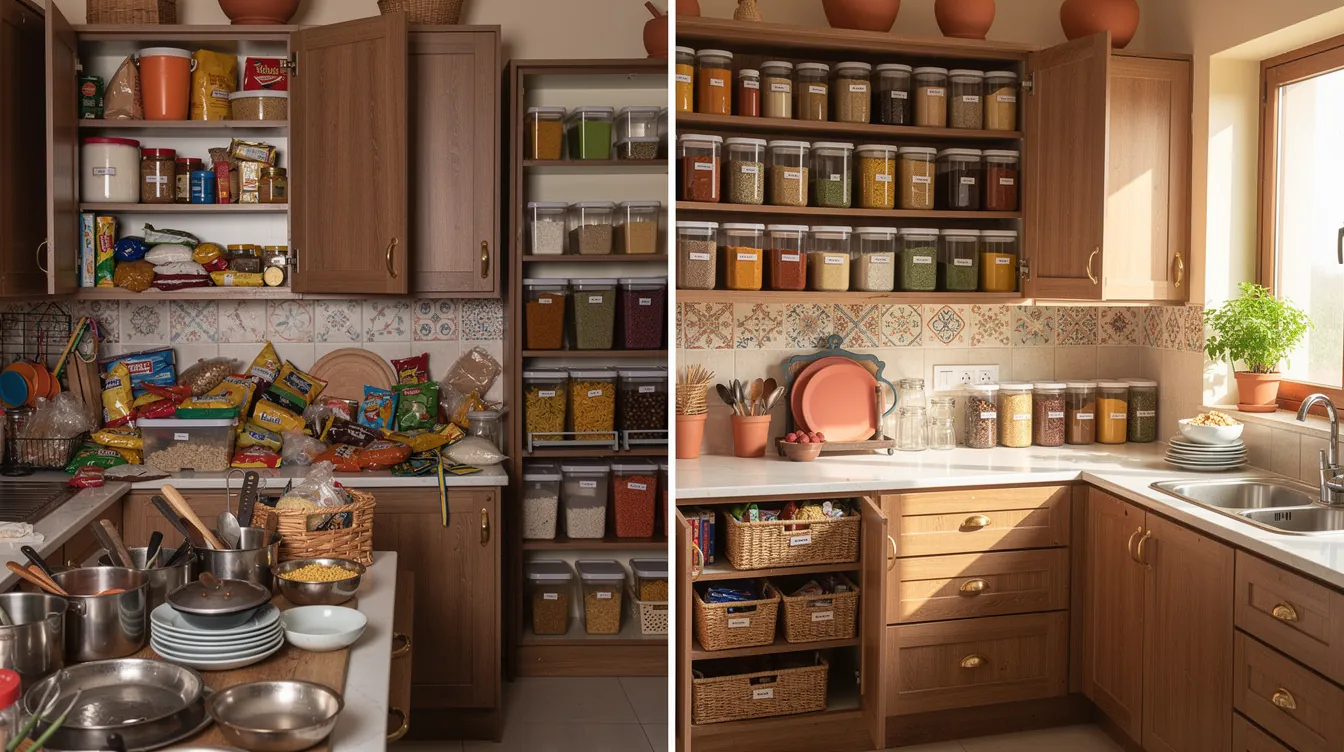
Before-and-after of an Indian kitchen in Bangalore: cluttered countertops and disorganised cabinets on one side, and the same kitchen with clear surfaces and labelled storage containers on the other
non-modular kitchen kitchen organisation small kitchen organisation indian kitchen storage ideas organising tips

How to Organise a Non-Modular Kitchen: A Practical Guide for Indian Homes

Tidy Blueprints Team
Professional Home Organizers, Bangalore
October 9, 2026 12 min read
Jump to section

Many Indian homes still have a non-modular kitchen: a stone cooking platform, open shelves underneath, a few wall shelves or a loft above, and perhaps a curtain where cabinet doors would be. It is a sturdy, practical layout, but without drawers, pull-outs and built-in dividers, things pile up fast. If you have been wondering how to organise a non-modular kitchen without tearing it out, the good news is that most of what a modular kitchen does can be added with baskets, racks and a clear plan.

Why Is a Non-Modular Kitchen Hard to Organise?

A non-modular kitchen is hard to organise because most of its storage is deep, open, fixed shelving with no drawers or pull-outs. Items at the back go out of sight, small tools have nowhere to live, and open shelves collect dust and cooking grease. The fix is to add the missing pieces (baskets that work like drawers, risers that add a second level, and storage on the walls) rather than to rebuild.

What a typical non-modular kitchen looks like

  • A fixed cooking platform of granite, kadappa or another stone, often with the sink set into it.
  • Open shelves below the platform, usually stone or concrete slabs, sometimes behind a curtain or carpenter-made shutters.
  • A few wall shelves, a wall-mounted plate rack, or a loft above the platform or the door.
  • Little or no drawer space for cutlery, spoons and small tools.

Where the clutter comes from

  • Depth without access. Under-counter shelves are deep. Whatever gets pushed to the back is forgotten, and you have to bend and reach for everything.
  • No drawers. Spoons, peelers, lids and small packets end up in a box or loose on the platform.
  • Open storage. Dust and grease settle on everything kept in the open, so the kitchen looks messier than it is.
  • Unused height. Fixed shelves are often much taller than the containers on them, and the space above a single row of jars goes to waste.

The upside of a non-modular kitchen

A non-modular kitchen is also flexible. Nothing is tied to a module size, so you can change the layout whenever you like, try a basket here and a rack there, and take most of your storage with you when you move, which makes it ideal for renters. Organising it well costs a fraction of what a new modular kitchen would.

Start Here: Declutter and Plan Your Kitchen Zones

Before you buy a single rack, empty one area at a time, let go of what you don't use and decide where each category will live based on how you cook. In a non-modular kitchen this step matters even more, because the storage itself is fixed: you can't move a shelf, but you can change what goes on it. Our kitchen organisation guide covers the full method in detail.

Empty and edit one section at a time

Clear one shelf or one corner at a time rather than the whole kitchen at once. Wipe the shelf, check every item and sort it into keep, donate or discard. Be honest about duplicates: three graters, five ladles and a pile of takeaway containers are common. Check dals, flours and spices for expiry dates and weevils.

Map your zones

A kitchen works best when things are stored where they are used. Plan four or five zones:

  • Cooking zone (beside the stove): oils, the masala dabba, salt, ladles, tawa and kadai.
  • Prep zone (the clearest stretch of platform): chopping board, knives, peelers, mixing bowls, the mixer-grinder.
  • Cleaning zone (the sink and under it): dish soap, scrubbers, cloths, the dustbin.
  • Storage zone (lower shelves, a rack or the loft): dals, rice, atta and bulk stock.
  • Serving zone (a wall shelf or plate rack near where you eat): plates, glasses and bowls.

Store things by how often you use them

Daily-use items go between knee and shoulder height, closest to their zone. Weekly items go lower down or towards the back of a shelf. Festival vessels, the big pressure cooker you use for guests and spare stock go up to the loft or the highest shelf.

Key Takeaway: Declutter and zone first, buy later. Measure the width, depth and height of every shelf before you order a rack or basket, because the shelves in a non-modular kitchen are rarely standard sizes.

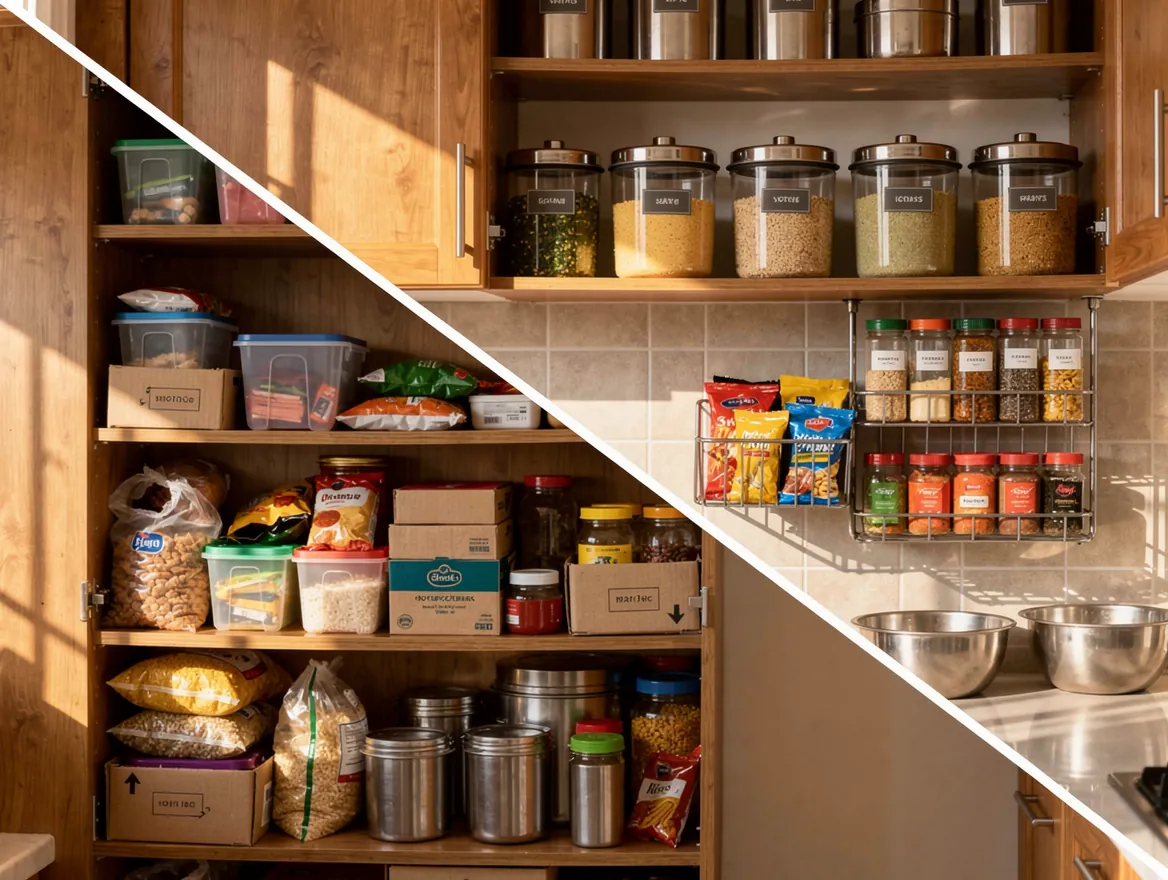
Before-and-after of a Bangalore kitchen pantry with wooden shelving: open plastic bags and mixed containers stacked haphazardly on one side, and the same shelves organised with labelled glass and steel containers, wire pull-out organisers and shelf dividers on the other

How to Organise Under-Counter Open Shelves

Organise under-counter open shelves by turning them into pull-out storage with baskets and bins, adding a second level with risers or two-tier racks, and keeping heavy vessels at the bottom. These shelves are usually the biggest storage space in a non-modular kitchen, and the one that most needs structure.

Use baskets and bins as drawers

The most useful single change is to put everything on a deep shelf into baskets or bins with handles. Pull the basket out and you can see and reach the back of the shelf, which is exactly what a drawer does. Give each basket one category: lids, small vessels, plastic boxes, cleaning supplies. Wire baskets and plastic bins are easy to wipe and cope with moisture better than cane or cardboard.

Add a second level

Most under-counter shelves are taller than what sits on them. A shelf riser or a two-tier wire rack creates a second level: plates below and bowls above, or small vessels below and tiffin boxes above. Measure the height first so you can still lift things out comfortably.

Keep heavy vessels low and lids separate

Pressure cookers, kadais, idli stands and tawas belong on the lowest shelf, where lifting them is safest. Store lids separately in a lid organiser (a simple file holder or a vertical rack works well) so every lid is visible and you don't have to unstack three cookers to reach one. Stand plates and tawas upright in a plate rack instead of stacking them.

Line the shelves and cover the front

Stone shelves are easier to keep clean with a washable shelf liner: when it gets greasy, lift it out and wash it. To keep dust and grease off what's stored, hang a curtain on a tension rod or fit a simple roller blind across the front. If you own your home, a carpenter can add plain shutters to the existing shelves without replacing the kitchen.

Organise under the sink

The space under the sink usually has pipes running through it. A two-tier under-sink rack, or a couple of slim bins on either side of the pipe, keeps dish soap, scrubbers and cleaning liquids upright and contained. Put a small tray at the bottom to catch drips, and keep cleaning chemicals away from food and out of children's reach.

Add Storage Without a Renovation: Walls, Racks and Trolleys

If your non-modular kitchen simply doesn't have enough storage, add it on the walls and with freestanding units: rails, magnetic strips, slim shelves, a kitchen rack or a rolling trolley. None of these needs a renovation, and most can come with you when you move.

Put the wall above the platform to work

  • Rails with S-hooks for ladles, spatulas, tongs and small strainers, off the counter and within reach of the stove.
  • A magnetic knife strip to make up for the drawer you don't have.
  • A wall-mounted spice rack or slim shelf for oils and everyday masalas, placed away from the direct heat of the stove.
  • An over-sink drying rack, which adds a whole shelf of storage above the sink without using any counter space.

If you rent, use strong adhesive hooks and rails, or freestanding racks, instead of drilling. For more ideas, see our kitchen shelf organiser guide.

Bring in a freestanding kitchen rack

A freestanding multi-tier rack or kitchen organiser stand can hold a microwave or OTG on top, with containers, plates or a fruit basket on the shelves below. Steel or powder-coated metal handles heat, moisture and the weight of Indian vessels better than particleboard. Our guide to kitchen organiser stands compares the types and materials.

Add a rolling trolley

A slim three-tier trolley on wheels can slide into the gap beside the fridge or at the end of the platform. Use it for onions and potatoes, snacks, or bread and breakfast things. Because it moves, you can roll it to where you are working and push it back afterwards.

Use the loft for occasional items

The loft is ideal for things you use a few times a year: festival vessels, large serving dishes and extra stock. Keep them in labelled, lidded boxes rather than loose, keep heavy items out of the loft altogether, and keep a sturdy step stool handy. A simple list of what's up there stops you buying things you already own.

Key Takeaway: In a non-modular kitchen, the walls and the gaps are your modular units. Every rack you add should take something off the platform.

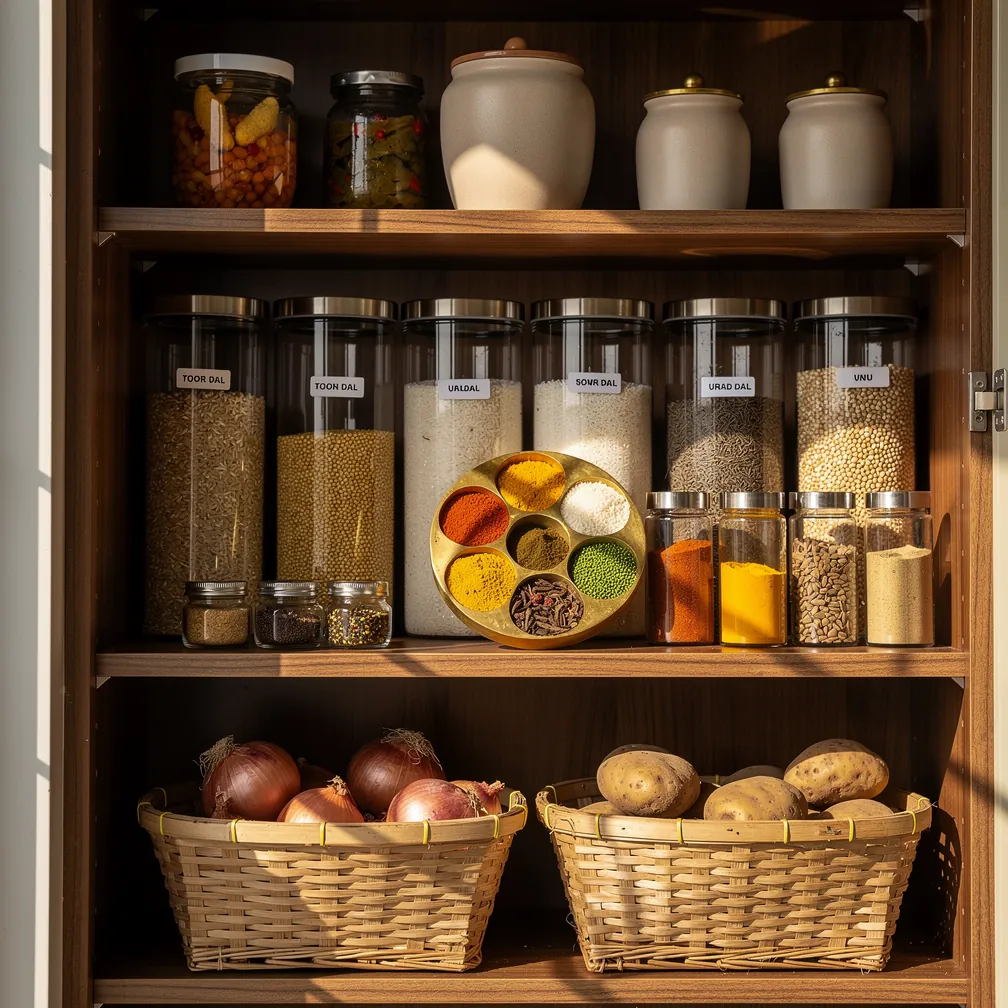
Open teak wood kitchen shelves lined with labelled airtight glass and steel containers of rice, dals and spices, with a brass masala dabba on the middle shelf, in warm natural daylight

How to Organise Dry Goods, Masalas and the Counter

Organise dry goods in a non-modular kitchen by moving staples into uniform, airtight, labelled containers, keeping a small daily supply near the stove with the bulk stock further away, and reserving the counter for daily-use items only. Open shelves show everything, so matching containers make the biggest visual difference.

Decant staples into airtight containers

Rice, dals, atta, rava, sugar and poha keep better and stack more neatly in airtight containers than in their packets. Glass and steel seal well and don't hold on to smells, and clear containers show you when stock is running low. Choose square or rectangular containers where you can, because they use shelf space better than round ones. Our guide to kitchen organiser boxes compares materials, lids and sizes.

Label everything

Labels end the "is this atta or maida?" guessing and help everyone in the family put things back in the right place. Masking tape and a permanent marker cost under ₹50 and work perfectly. Add the date you filled each container so the older stock gets used first.

Split daily stock from bulk stock

Keep the masala dabba and one container of each everyday staple near the stove. Store the big bags and refill stock on a lower shelf, in the trolley or in the loft, and top up the small containers once a week. The cooking zone stays clear while the bulk stays out of the way.

Monsoon-proof the pantry

Bangalore's monsoon, roughly June to September, brings humidity that can spoil dry goods and invite weevils. Use glass or steel containers through the humid months, keep silica gel sachets on the spice and dal shelves (not inside the food), and check grains and flours every week. Make sure pickle jars keep their protective layer of oil.

Keep the counter for daily-use items only

In a kitchen with no drawers, the platform quickly turns into storage. Limit it to what you use every day: the stove, the mixer-grinder if you use it daily, a tray with oil, salt and the masala dabba, and a utensil holder. Grouping small things on a tray also makes the platform quick to wipe down. For more ideas, see our guides to kitchen counter organisers and kitchen pantry organisation.
How to Keep a Non-Modular Kitchen Organised

A non-modular kitchen stays organised with a quick daily reset, a weekly check of the shelves and a monthly look at whatever has crept back in. Because the storage is open, small slips show quickly, but they are also quick to fix.

  • Daily (5 minutes): wipe the platform, hang tools back on the rail or drop them in their basket, and return containers to their shelf.
  • Weekly (10 minutes): refill everyday containers from bulk stock, wipe the shelf liners and check the vegetables in the trolley.
  • Monthly: check expiry dates, clear out the pile of plastic bags and takeaway boxes, and adjust any zone that isn't working.

Living with a new system for a week or two is the best test. If you keep reaching to the wrong side of the stove for the spatulas, move them. Good small kitchen organisation follows the way you actually cook, not the way a photo says you should.

When to get help

If the kitchen keeps slipping back despite your efforts, or you're setting up a new home and want it right from the start, a professional organiser can help. Tidy Blueprints organises kitchens in homes across Bangalore: we declutter with you, plan the zones around how your family cooks, and set up the containers, racks and labels so the system is easy to keep. Learn more about our kitchen organisation service in Bangalore, browse more kitchen organisation ideas, or book a virtual consultation if you live outside the city.

Non-Modular Kitchen Organisation FAQs

What is the difference between a modular and a non-modular kitchen?

A modular kitchen is built from ready-made cabinet units with shutters, drawers and pull-outs in standard sizes. A non-modular kitchen has a built-in platform with fixed stone or concrete shelves underneath, sometimes with curtains or carpenter-made shutters. It has less built-in organisation, but it is easy to change and to organise with baskets, racks and freestanding units.

Which non-modular kitchen organiser should I buy first?

Start with pull-out baskets or bins for the under-counter shelves, because they turn deep, dark shelves into drawer-like storage. After that, add a lid organiser, a wall rail with S-hooks for ladles, and a set of matching airtight containers for staples. Measure every shelf before you buy anything.

How can I add drawers to a non-modular kitchen?

Baskets and bins with handles on the existing shelves work like drawers and need no tools. A freestanding plastic or metal drawer unit can also fit under the platform. If you own your home, a carpenter can fit pull-out baskets on telescopic channels to the existing shelves without rebuilding the kitchen.

How do I keep open kitchen shelves free of dust and grease?

Line the shelves with washable liners, keep things in lidded containers or baskets rather than loose, and hang a curtain on a tension rod or fit a roller blind across the front of the under-counter shelves. Keep oils and masalas away from the stove's direct heat and wipe the shelves during your weekly reset.

Can I organise a non-modular kitchen in a rented home?

Yes. Almost everything in this guide works without drilling: baskets, shelf risers, a rolling trolley, a freestanding rack, adhesive hooks and rails, and a curtain on a tension rod. All of it comes with you when you move.

How much does it cost to organise a non-modular kitchen yourself?

A basic set of organisers (a few wall hooks, shelf risers, airtight containers and labels) typically costs around ₹1,000–₹1,500 at market prices. Baskets, a trolley or a freestanding rack add to that depending on size and material. Declutter first, so you buy only what you need.

Want Help Organising Your Kitchen?

Tidy Blueprints organises kitchens in homes across Bangalore, decluttering, zoning and setting up storage that suits the way your family cooks.